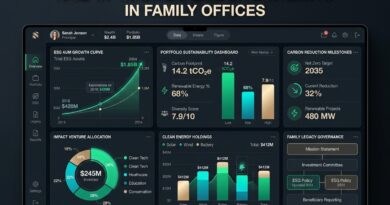

The Rise of ESG Investment in Family Offices
Family offices are no longer treating environmental, social and governance investing as a reputational add-on. For a growing number of wealthy families, ESG has become part of portfolio construction, risk management and intergenerational wealth planning.
The shift is not uniform. Some family offices remain sceptical of ESG labels, especially after several years of political backlash, inconsistent data and concerns about greenwashing. Yet the direction of travel is clear: sustainability considerations are increasingly being integrated into investment decisions, particularly where families take a long-term view of capital preservation.
According to UBS, around 39% of family offices globally now align at least part of their investment strategy with ESG criteria. That figure does not suggest a wholesale transformation of the sector. It does, however, show that ESG has moved beyond philanthropy and into the investment committee.
From Values to Risk Management
Family offices have traditionally been conservative investors. Their mandate is often broader than performance alone: preserve capital, protect legacy, manage succession and maintain flexibility across generations.
This makes the ESG debate more relevant, not less. Climate risk, regulatory pressure, supply-chain exposure and reputational damage are no longer abstract concerns. They can affect asset values directly, from real estate and infrastructure to private equity and public markets.
For many families, ESG is therefore becoming less about moral positioning and more about identifying risks that conventional financial analysis may overlook. Energy efficiency, governance quality, labour standards and climate resilience increasingly feed into the assessment of long-term value.
The Next Generation Changes the Conversation
The strongest pressure often comes from within the family itself. Millennial and Gen Z heirs are more likely to ask whether capital reflects family values, not only whether it produces returns.
This does not mean younger family members are indifferent to performance. Rather, they tend to view sustainability and financial discipline as linked. For them, avoiding stranded assets, weak governance or environmentally exposed sectors can be part of prudent wealth management.
This generational shift is changing the role of family offices. Investment teams are expected to explain not only what the portfolio owns, but why. Reporting, transparency and impact measurement are therefore becoming more important.
Europe Sets the Pace
Regulation is another driver. In Europe, ESG disclosure rules have become more demanding, even if the framework remains complex and at times contested. Asset managers, banks and advisers are under pressure to provide more detailed information on sustainability risks and product classifications.
Family offices are not always regulated in the same way as institutional investors. But they are affected indirectly through their banks, fund managers and external advisers. As a result, many are being pulled into a more structured ESG reporting environment.
This creates both a burden and an opportunity. Families with fragmented portfolios, multiple custodians and private-market exposure often struggle to obtain a consolidated view of their sustainability profile. Those that invest in better data infrastructure may gain a clearer picture of risk, concentration and long-term exposure.
Private Markets Are Central
ESG integration is particularly relevant in private markets, where family offices often have more influence than they do in listed equities. Direct investments, real estate holdings, venture capital and private equity allow families to shape governance standards, reporting expectations and strategic priorities more directly.
Renewable energy, sustainable agriculture, energy-efficient buildings, healthcare, education and climate technology are among the areas attracting long-term family capital. These sectors appeal not only because of their sustainability profile, but because they are linked to structural economic trends.
The challenge is discipline. ESG-labelled investments are not automatically good investments. Family offices still need rigorous due diligence, realistic return assumptions and clear reporting standards. The sector has learned that good intentions do not replace investment judgement.
The Data Problem
One of the main obstacles remains measurement. ESG data is inconsistent, ratings providers often disagree, and private-market reporting can be incomplete. For family offices with complex wealth structures, the problem is even sharper.
A consolidated portfolio may include listed securities, private equity funds, direct company stakes, property, art, cash, philanthropy and operating businesses. Measuring ESG exposure across such a structure is difficult.
That is why technology is becoming more important. Wealth platforms that aggregate financial and non-financial assets can help families understand where capital is allocated, how risks are distributed and where sustainability objectives are being met or missed.
For family offices, the future of ESG will depend less on slogans and more on data quality, reporting discipline and governance.
What Family Offices Should Do Next
Family offices considering deeper ESG integration should start with clarity. The first question is not which ESG product to buy, but what the family wants to achieve.
Some families may prioritise climate risk reduction. Others may focus on impact, philanthropy alignment, governance standards or avoiding reputational exposure. The investment strategy should follow the family’s mandate, not the latest market label.
Practical steps include:
- defining the family’s ESG priorities;
- mapping current portfolio exposure;
- improving data collection across banks, funds and private assets;
- setting reporting standards for external managers;
- involving the next generation in investment discussions;
- distinguishing clearly between ESG integration, impact investing and philanthropy.
This distinction matters. ESG integration is mainly about risk and opportunity. Impact investing aims to generate measurable social or environmental outcomes alongside financial returns. Philanthropy pursues non-commercial objectives. Confusing the three can lead to poor governance and unrealistic expectations.
Outlook: ESG Becomes More Selective
The next phase of ESG investing in family offices is likely to be more selective and more demanding. The easy narrative of “doing well by doing good” has become insufficient. Families want evidence, comparability and accountability.
That does not weaken the case for ESG. It strengthens it. As the market matures, vague commitments will give way to more disciplined approaches focused on material risks, measurable outcomes and long-term capital preservation.
For family offices, ESG is no longer simply a question of reputation. It is becoming a question of governance: how wealth is managed, how risk is understood and how capital is prepared for the next generation.