How Real-Time Is Your Wealth Report?
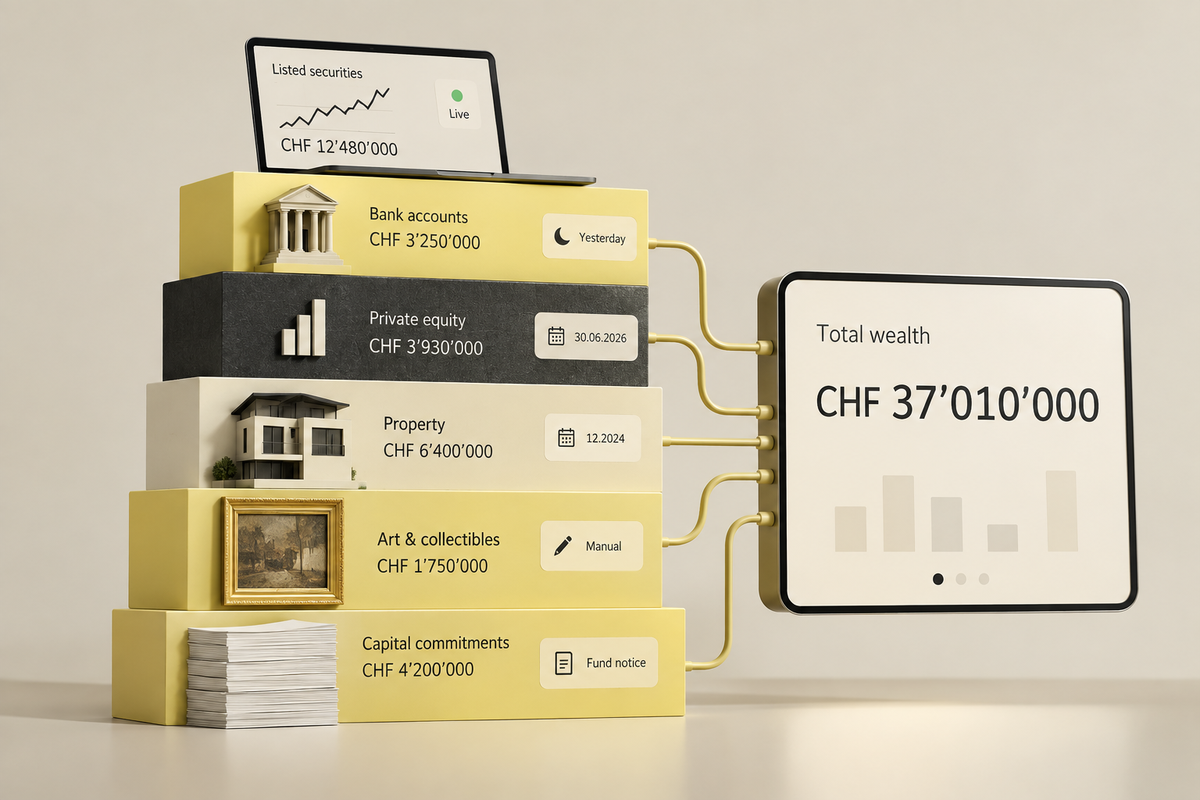
A wealth dashboard opened this morning might contain share prices from this morning, yesterday’s bank balances, a private-equity valuation from June and a property appraisal completed last year. They still appear under one total.
Digital wealth reporting has made it far easier to bring banks, portfolios, companies, private funds and physical assets onto one screen. Wealth managers now receive bank feeds automatically, connect custodians through APIs and update market prices throughout the day. The dashboard itself is current.
The assets inside it run on different clocks. For clients with complex wealth, the distinction affects more than presentation. A total net-worth figure of CHF 42 million looks precise. Its components might include CHF 18 million of listed investments priced today, CHF 8 million of private funds carrying their latest reported NAV, CHF 12 million of property from the last appraisal and CHF 4 million of other assets updated manually. So what date does CHF 42 million actually represent?
What does “real time” mean in a wealth report?
For listed securities, the answer is relatively straightforward. Market-data providers supply current prices, and portfolio systems update valuations as new prices arrive. Cash balances and transactions arrive through bank feeds, although the frequency depends on the custodian, connection and reporting setup.
Software vendors therefore use terms such as real time or near real time with some justification when they describe the movement of banking and market data through their systems.
Avaloq, for example, describes its data infrastructure as making core-banking data available in near real time. Other wealth platforms bring connected bank positions into a consolidated book daily and update marketable securities using current pricing and foreign-exchange data.
None of that makes a private company, property or private-equity fund real time. A dashboard refreshes when new information reaches it. It does not create a new valuation for an asset simply because the client opened the application today.
Why are private-market figures older?
Listed securities have observable market prices but the private assets do not. A private-equity fund values the companies in its portfolio, completes its reporting process and sends investors a new NAV. The process takes time. MSCI found that even 90 days after a quarter ended, only about 80 percent of private-capital fund valuations in its sample had been reported. Fourth-quarter reporting took longer.
Other industry research puts the reporting lag for private-equity and venture-capital valuations at three to six months in some cases. A client looking at a wealth report in September could therefore see a private fund carrying a valuation dated 30 June. In some portfolios, the latest available figure will be older. The system has not failed. It is displaying the latest official valuation it has received. Problems start when the reporting interface makes that June valuation look indistinguishable from an equity position priced on 16 September.
Does the total wealth figure have one valuation date?
Not necessarily.
Imagine a family whose report contains seven categories:
Listed securities use current market prices. Cash came through last night’s bank feed. The private-equity portfolio carries the latest quarterly NAVs. A property remains at the value from its most recent appraisal. Art was entered manually after the last insurance valuation. Foreign assets use a current exchange rate. Uncalled private-equity commitments come from the latest fund notices. The software can calculate a total from all seven. The arithmetic is current but the underlying valuations are not.
Foreign exchange makes the issue easier to miss. A EUR private-equity position valued three months ago can be translated into CHF using today’s EUR/CHF rate. The CHF number changes even though the fund itself has not issued a new NAV. Part of the displayed movement comes from currency; the value of the underlying investment remains anchored to an older reporting date.
A consolidated total therefore represents the latest information available for each component, converted and assembled according to the reporting system’s rules. Clients need the dates behind those components to understand what the headline number contains.
What happens with property, art and private companies?
These assets often rely on manual or document-based updates. A family office might enter a property valuation after receiving an appraisal. A private-company stake might use a valuation agreed for financial reporting, a financing round or another documented reference point. Art and collectibles might stay at an insurance value, acquisition cost or specialist valuation until someone provides a replacement figure.
Modern software makes the administrative work easier. It stores the asset, links documents to it and records a new value when one arrives. Some platforms extract figures directly from valuation statements and fund reports instead of requiring someone to type them into the portfolio system. Automation changes how quickly information reaches the report. It does not change how often the underlying asset is valued. A painting valued once a year remains an annually valued asset even when the software processes the valuation certificate in seconds.
How do I know which figures are current?
The report needs to show more than value. For an asset without an observable market price, the valuation date tells the reader when the number was established. The source explains where it came from. The method indicates whether the figure represents a market price, fund NAV, appraisal, manually entered value or another basis.
Some current wealth platforms already expose that information. WealthArc, for example, describes reports in which individual holdings identify whether the data arrived through a feed, came from a document or was entered manually. Its private-market functions also record when a valuation was last refreshed. Swiss reporting providers use defined cut-off dates for formal reports rather than presenting every consolidated figure as if it belonged to the same moment. This piece of information belongs close to the number it qualifies. A client should not have to work backwards from a CHF 6.2 million private-equity position to discover that the valuation is from the previous quarter.
Can software estimate what a private asset is worth today?
An estimate and an official valuation answer different questions. A wealth manager might use market movements, comparable companies or other information to assess how a private holding has developed since its last formal valuation. Some reporting systems also support estimated or manually adjusted values.
The report then needs to preserve the distinction between the reported NAV and the estimate. Replacing an old official valuation with a newer estimate without labelling the change would make the dashboard look more current at the cost of telling the client less about what the number represents.
For wealth reporting, provenance matters as much as freshness. A three-month-old fund NAV with a clear date and source gives the reader more information than a current-looking number with an unclear basis.
What happens when a new NAV arrives late?
Private-market reporting creates another timing problem. Suppose a fund reports its 30 June NAV in September. The wealth platform receives the figure and updates the holding. The valuation belongs to June even though the system received it in September.
Historical performance reporting then needs to place the new information in the correct period. SEI has highlighted this problem in private-equity reporting. Custodians often use official fund valuations rather than estimates, and those NAVs arrive months after the period they describe. Reporting systems therefore need a way to apply the later information to the correct historical date. For the client, two dates matter: when the wealth manager received the information and when the valuation applies. A well-built report keeps them separate.
Is a PDF report different from a live dashboard?
Yes.
A formal report normally works from a defined reporting or cut-off date. The figures are assembled, checked and preserved as a record of the portfolio at that point. A dashboard keeps changing as new market prices, transactions and documents arrive. Both have a purpose. The PDF provides a reproducible record. The dashboard provides a changing operational view.
Confusion starts when a client reads the dashboard as though every number had undergone the same point-in-time reporting process as a formal statement. The faster interface is not automatically the more authoritative record.
What should I expect from my wealth manager?
A useful digital report makes differences in timing visible rather than smoothing them away.
Current listed assets should carry current market data. Private investments should show their relevant valuation dates. Manually maintained assets need an identifiable source or update date. Estimates need to look like estimates. Capital commitments should reflect the latest information supplied by the fund manager.
The wealth manager also needs to know which parts of the portfolio arrive automatically and which still depend on documents or manual input.
For you as a client, the number at the top of the dashboard is only the starting point. The more important question for you to ask is how fresh the information underneath it is.
Questions for your wealth adviser
01 What date does the total wealth figure in my dashboard actually represent?
02 Which assets update automatically and which depend on statements, appraisals or manual entries?
03 Can I see the valuation date and source for every private or non-bankable asset?
04 When you receive a private-fund NAV late, does the system apply it to the historical period it belongs to?
05 Do you distinguish clearly between official valuations and estimates?
A wealth report does not need every asset to update at the same speed. It needs to tell the client which numbers are current, which belong to an earlier date and where each value came from.