What Should Family Wealth Preserve When Markets Will Not?
A luxury resort in Puglia has brought forgotten seeds back into cultivation. The harder question for family philanthropy begins with the varieties, knowledge and cultural assets that nobody can make pay.
Angelo Giordano spent years looking for seeds that most commercial growers had stopped wanting. Old farmers gave him varieties their families had kept alive. He searched agricultural records, followed word of mouth and swapped material with other seed savers. Until recently, most people outside that small world had little reason to know his name.
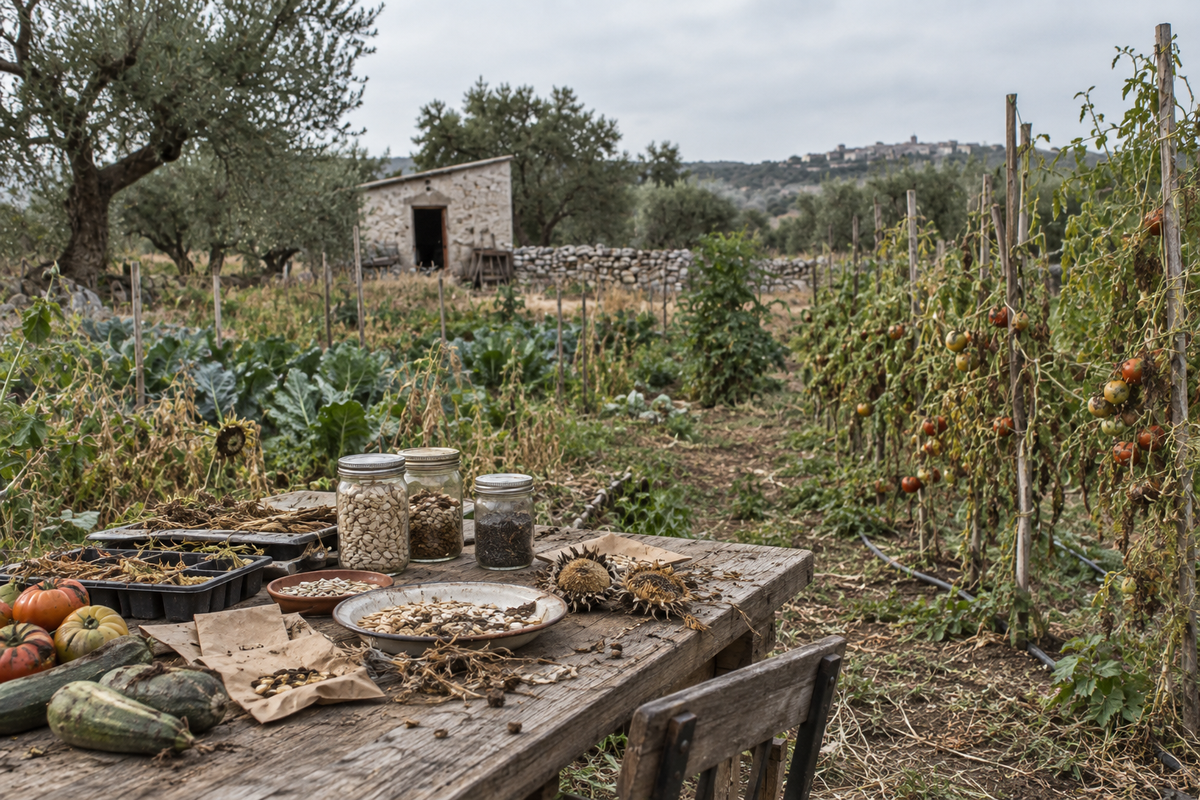
Borgo Egnazia changed his audience. The luxury resort in Puglia brought Giordano in as its agronomist and seed saver and built the Casa delle Sementi around his work. Chef Domingo Schingaro, who runs the Michelin-starred Due Camini, began testing recovered vegetables in the kitchen. By September 2026, Giordano was growing about 240 tomato varieties and working with a network of roughly 30 producers; around 30 recovered varieties had already reached Schingaro’s menu. Borgo Egnazia says the wider project has recovered more than 500 old varieties during 2026.
A luxury hotel has given some of those plants something preservation projects often struggle to find: a customer.
One smooth black chickpea from the Murgia shows how slowly the process works. Schingaro told Vanity Fair Italia that the project had recovered only 15 seeds. The team planned to use them for multiplication rather than cooking and expected to spend several years building enough stock before producing chickpeas for the restaurant.
For the resort, the wait eventually leads somewhere commercial. A forgotten tomato acquires another life when a chef wants it, diners eat it and growers have a reason to plant it again. The Casa delle Sementi deliberately goes beyond storage: staff extract, clean and test seeds, multiply them in the fields and share them with others.Many threatened assets never find the restaurant.
Nine Crops Produce Two-Thirds of Global Crop Output
Agriculture once used a much larger range of plants. More than 6’000 species have been cultivated for food, according to the UN Food and Agriculture Organization, yet fewer than 200 now make major contributions to global food production. Nine crops account for 66 percent of total crop output.
Farmers did not abandon thousands of varieties for no reason. Higher yields, predictable harvests, uniform products and established distribution make commercial agriculture work. Processors need consistency; retailers need volume. A regional bean grown by a handful of farmers competes badly with a variety that delivers both.
Plant breeders still need genetic material outside the crops dominating supermarket shelves. Old varieties and wild relatives carry traits associated with drought, heat, salinity and disease. CGIAR’s international genebanks hold almost three-quarters of a million crop accessions, and breeders draw on such material when existing commercial varieties lack the genetic variation required for changing conditions.
Nobody knows which forgotten variety will contain a trait agriculture needs thirty years from now. Borgo Egnazia has solved part of the economic problem by connecting preservation with hospitality. A tomato moves from Giordano’s collection into Schingaro’s kitchen, guests discover it and a grower eventually gains another buyer. The resort has an incentive to fund the system because local agriculture also contributes to the food and identity it sells. A seed that tastes unremarkable, produces badly or interests no chef has no equivalent route to revenue.
Who Pays for the Seed Nobody Wants?
The same problem appears across preservation. A historic archive requires cataloguing before anybody knows what it contains. An endangered craft needs another practitioner before the last one retires. A plant collection needs land, expertise and maintenance year after year.
Owners usually carry those costs while much of the benefit goes elsewhere. OECD research on biodiversity finance acknowledges the mismatch. Many conservation and restoration projects offer limited or uncertain financial returns, leaving public and philanthropic money to fund work private investors have little reason to take on. Where a business model does exist, private capital enters more easily.
Family offices therefore face a capital-allocation decision that disappears when advisers put every environmental project under the same impact-investing label. A commercially viable regenerative farm belongs in an investment portfolio if its expected return justifies the risk. Early grant funding might help a conservation project reach the point where customers or investors take over. Other work will never produce enough revenue to repay the capital behind it.
Forcing the third group to promise a financial return does not make the projects more disciplined. It changes which projects receive money. Private philanthropy already finances part of the shortfall. OECD figures put philanthropic funding for biodiversity at an average of about USD 665 million a year from 2017 to 2022. Foundations provided almost USD 1 billion in 2021, followed by USD 700 million in 2022; reported private philanthropic biodiversity finance stood at USD 610 million in 2023. The numbers remain small against the scale of global private wealth. They also raise a harder allocation problem than the headline total suggests. A donor still has to decide why one threatened asset deserves twenty years of funding while another does not.
Preservation Needs an Exit Decision Too
Giordano’s work gives one possible test. He does not collect seeds simply because they are old. His team researches their provenance, grows them, sees how they perform and tries to return them to agriculture. Some reach restaurants. Others need further multiplication. The collection remains connected to farmers who still know the plants and the places from which they came.
A family foundation funding preservation needs similar discipline. Irreplaceability comes first. Money spent later cannot recreate extinct genetic material or recover knowledge nobody recorded. Another consideration is future use: crop genetics that have little commercial relevance today may matter to breeders under different climatic conditions. Donors also need to know whether somebody else already has both the mandate and the resources to protect the asset.
Duration changes the governance. A founder may care deeply about a seed collection, landscape or archive; her children may not. Twenty years of funding therefore requires more than an annual grant. Someone has to define what the family intends to preserve, who controls the programme, how results are recorded and under what circumstances funding ends.
The people around the asset complicate matters further. Giordano relies on farmers willing to share seeds and the knowledge attached to them. Some varieties survived because one family continued cultivating them after commercial growers moved elsewhere. According to la Repubblica, the producer network now sometimes works in reverse: farmers contact Giordano when an old plant reappears in a garden or when they find traces of a variety thought to have disappeared.
Buying the seed does not buy that network. A family funding an archive encounters archivists and historians. A traditional workshop depends on practitioners capable of teaching someone else. Conservation projects depend on scientists, landowners and local communities. Long-term funding has to preserve enough of the system around an asset for the asset to remain usable.
Five Questions Before a Family Funds Preservation
01 What disappears permanently if funding stops? A temporary shortage of money calls for a different response from the loss of genetic material, an archive or knowledge held by one ageing practitioner.
02 Who still knows how to use it? Preservation needs the farmer, researcher, craftsperson or archivist as well as the physical asset.
03 Has somebody already found a commercial model? Investment capital belongs where customers and credible returns exist; philanthropy has a clearer role where the benefit cannot be captured by the funder.
04 Does preservation require activity? Seeds need cultivation and multiplication. Crafts need practitioners. Archives need cataloguing and access.
05 Who takes over after the donor? A multi-decade commitment needs governance and funding beyond one family member’s interest.
Some Seeds Will Never Reach the Menu
Borgo Egnazia gives Giordano an unusual laboratory. A luxury resort has land, chefs, guests and purchasing power in the same place. Schingaro can taste what Giordano grows, select varieties for his kitchens and create demand around ingredients the conventional food chain had ignored.
The arrangement explains why Giordano’s work suddenly travelled well beyond seed-saving circles. Vogue Italia featured Borgo Egnazia’s regenerative agriculture project in 2026; Italian food publications followed the Casa delle Sementi, and la Repubblica recently profiled the agronomist cultivating hundreds of tomato varieties inside one of Puglia’s best-known resorts.
Some recovered crops will taste good enough, grow reliably enough and interest enough diners to establish a small market. Others will remain expensive to maintain and commercially marginal even though their genetic material, local history or future usefulness argues against letting them disappear.
Those are the cases where a wealthy family faces a decision that no expected-return calculation will make for it: whether to keep paying for something precisely because nobody else has an economic reason to do so.
Note: The Rotharia Editorial Team came across Angelo Giordano’s work in “The Seed Librarian”, published in BILLIONAIRE’s Issue 2 2026, and wanted to share it because it raises a bigger question for family wealth: what is worth preserving when the market no longer gives anyone a reason to keep it alive?