
Global Trends in Private Market Liquidity
Private markets have expanded rapidly, but the mechanisms for leaving them have not kept pace. With assets estimated at about $6 trillion globally, investors are paying closer attention to secondary transactions, continuation funds and other structures that can return capital before an underlying asset is sold or a fund reaches the end of its life. These solutions are widening the options available to investors, but they do not turn private assets into liquid securities: prices remain negotiated, information uneven and transactions considerably more complex than trading on a public exchange.
For much of their history, private equity, venture capital and other private-market investments were defined by their illiquidity. Investors committed capital for periods that could extend beyond a decade, with limited opportunities to sell before a company was acquired, listed or otherwise realised. That constraint was partly accepted in return for access to investments unavailable on public markets and the possibility of an illiquidity premium. As private markets grew, however, institutional portfolios accumulated larger exposures, distributions slowed and investors found themselves with capital tied up for longer than expected. At the same time, pension funds, insurers and family offices needed greater flexibility to rebalance portfolios, manage cash requirements or reduce commitments to particular managers. Liquidity therefore became more than an operational concern; it became part of portfolio construction.
The secondary market moves into the mainstream
The private-equity secondary market was originally associated with distressed sellers willing to accept steep discounts for an early exit, but it has developed into a more established part of the market, used by institutions managing allocations as well as investors facing immediate liquidity needs. In a secondary transaction, an investor sells an existing interest in a private-equity, venture-capital or private-credit fund. The buyer assumes the remaining commitments and gains exposure to a portfolio that is generally more mature than a newly established fund, which can shorten the time before distributions begin and give the buyer greater visibility into the underlying assets.
Nasdaq Private Market illustrates another part of this development. The platform facilitates transactions in shares of private companies, including liquidity programmes for employees and early investors, and is reported to have supported more than $12 billion in transactions since its inception. Such platforms provide a formal setting for trades that were once arranged through fragmented networks of brokers and advisers. The market is still far removed from a stock exchange: transactions may take weeks or months, buyers require extensive documentation and valuations are negotiated rather than continuously observable. Nevertheless, the expansion of secondaries has made private-market exposure more manageable.
Growth creates its own liquidity problem
Private-market assets under management were projected to reach $10 trillion by 2025, supported by institutional demand for private equity, infrastructure, real estate, venture capital and private credit. As allocations rise, so does the volume of capital that must eventually be returned, and this has become more difficult during periods when initial public offerings and corporate acquisitions slow.
When exit markets weaken, private-equity managers hold companies for longer. Investors receive fewer distributions while still being asked to commit capital to new funds, creating a liquidity mismatch in which portfolios may appear valuable on paper but produce less cash than expected. Secondary markets offer one response, with transaction volumes reportedly increasing by 50% over the past three years as investors seek to manage accumulated exposures. The growth is not driven only by sellers. Specialist secondary funds have raised substantial capital to acquire mature portfolios, often at discounts to reported net asset value. Their presence gives sellers more options, while buyers gain access to assets with shorter expected holding periods. The negotiation over price, however, remains central, because a reported valuation is not necessarily the value at which an asset can be sold.
Continuation funds redraw the exit
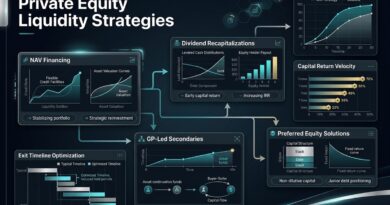
One of the fastest-growing liquidity structures is the continuation fund, through which a private-equity manager transfers a portfolio company from an older fund into a newly created vehicle rather than selling it to an external buyer. Existing investors can usually choose between selling their interest and rolling it into the new structure, while incoming investors provide fresh capital. For the manager, the arrangement creates more time to develop an asset that may still have further potential; for existing investors, it offers a route to liquidity without forcing an outright sale of the company.
The structure also creates conflicts because the same manager may effectively sit on both sides of the transaction, helping determine the price at which an asset moves from one vehicle to another. Investors must assess whether the transfer reflects fair value or primarily allows the manager to retain a successful asset and continue charging fees. Independent valuations, competitive bidding and transparent disclosure are therefore essential. Continuation funds can provide a legitimate solution to a difficult exit market, but they should not become a way to postpone weak performance or avoid recognising losses.
Private credit changes the liquidity equation
Private credit has become one of the fastest-growing areas of private markets, expanding more rapidly than many traditional fixed-income segments because investors may receive floating-rate income, stronger contractual protections and higher yields than those available in public debt markets. Borrowers, meanwhile, gain access to financing that can be negotiated more flexibly than a syndicated loan or bond issue.
Yet private credit is not inherently liquid. Loans are negotiated individually, documentation varies and secondary trading remains limited. In a stable market, this may matter little because investors expect to hold the debt to maturity, but during periods of stress the absence of a deep market can make valuations uncertain and exits difficult. The sector therefore illustrates a broader tension: private assets may offer attractive income and diversification precisely because they do not trade continuously. Attempts to make them more liquid can improve flexibility, but they may also reduce part of the return associated with accepting illiquidity. Investors should be cautious when products promise both private-market returns and near-public-market access to cash, because the two objectives do not always fit comfortably together.
Technology improves the plumbing
Financial technology is making private-market transactions more efficient by improving data collection, document management and communication between buyers and sellers. Digital platforms can centralise information on fund interests, underlying companies and capital calls, while standardised documentation reduces some of the administrative burden and automated workflows accelerate due diligence and settlement.
Blockchain-based systems have also been proposed as a way to record ownership, facilitate transfers and divide private assets into smaller units. Tokenisation could, in theory, allow investors to trade fractional interests more easily and create a wider pool of potential buyers. The technology does not, however, solve the central economic problem. A digital token representing an illiquid asset remains dependent on demand from another investor, and if the underlying company is difficult to value or the ownership transfer is restricted, placing the interest on a blockchain does not create meaningful liquidity. Technology can improve the infrastructure around a transaction, but it cannot guarantee a fair price or a willing counterparty.
Transparency remains uneven
Public-market investors receive regular financial statements, continuous pricing and detailed rules on disclosure, whereas private-market information is less consistent. Investors may receive quarterly valuations based partly on manager assumptions, underlying companies are not necessarily required to publish the same level of information as listed businesses and valuation methods can differ across funds.
This matters most when liquidity is needed. A seller may regard a fund interest as worth its latest reported net asset value, while a buyer adjusts that figure for company performance, leverage, remaining commitments and the time expected before distributions. In uncertain markets, the resulting discount can be substantial. Greater transparency could reduce this gap by making standardised reporting, more frequent portfolio information and clearer valuation methodologies available to buyers. It may also expose differences between reported values and prices available in the market. Liquidity brings information, but not always the information existing investors would prefer to see.
Regulation broadens access cautiously
Regulatory changes in Europe and Asia are gradually making private-market investments available to a wider group of investors through new fund structures and distribution frameworks designed to offer exposure to private equity, credit and infrastructure. Asset managers see this as a significant source of future growth, particularly as institutional allocations become more mature, but the expansion raises questions about suitability.
Institutional investors generally have the resources to assess complex fee structures, capital calls and long holding periods. Individual investors may be less prepared for assets that cannot be sold quickly or whose valuations are updated only periodically. Products designed for private clients therefore often include periodic redemption mechanisms or semi-liquid structures, which may hold part of the portfolio in cash or liquid securities to meet withdrawals. Such arrangements can work under normal conditions, but they become harder to sustain if many investors seek to redeem at once while the underlying private assets cannot be sold. Regulators face a difficult balance: broadening access without allowing the presentation of private assets as more liquid than they really are.
Liquidity has a price
Investors often discuss liquidity as though more were always better, but in private markets flexibility carries a cost. A seller seeking an early exit may accept a discount, a fund offering periodic withdrawals may need to hold lower-returning liquid assets and a manager arranging a continuation vehicle incurs advisory, legal and transaction expenses. Buyers, meanwhile, expect compensation for providing liquidity when it is scarce.
This makes the secondary market cyclical. When investors have abundant cash and confidence is high, discounts can narrow; when markets weaken and sellers need capital, buyers demand more favourable terms. The price of liquidity therefore depends on when it is needed most. Investors should consider this before making a commitment, not only when they are searching for an exit. Portfolio planning should include expected capital calls, distribution assumptions and the possibility that assets will remain private for longer than initially forecast.
Better access does not remove valuation risk
One argument for secondary markets is that more frequent transactions can improve price discovery, and that is broadly true because a portfolio interest that changes hands provides evidence of what an informed buyer is willing to pay. Private-market transactions are, however, highly specific. Two interests in the same fund may be priced differently because of their size, remaining commitments or the seller’s urgency, while a transaction involving one group of assets may provide limited guidance for another.
Private markets are also vulnerable to stale valuations. Managers may adjust their marks more slowly than listed markets respond to changes in interest rates or economic conditions, creating an apparent stability that disappears when an asset is sold. Liquidity solutions make it easier to realise a price; they do not ensure that the price will match the previous valuation.
Investors need to plan before committing
Private-market allocations should be built around realistic cash-flow assumptions because investors need to consider how much capital can be locked away, how future commitments will be funded and whether the portfolio can absorb a period of weak distributions. They should also understand which liquidity routes are available and what discounts or fees those routes may involve.
Diversification across vintages, managers and strategies can reduce the risk that too much capital becomes tied to the same market cycle, while secondary purchases may help by providing exposure to more mature portfolios. Advisers have an important role in explaining that liquidity is not a fixed characteristic. It changes with market conditions, the quality of the underlying assets and the urgency of the seller. A private investment should not be presented as liquid merely because a platform exists on which it might be sold. The relevant question is not whether an exit is theoretically possible, but how long it may take, at what price and under which conditions.
Managers face pressure to return capital
For private-market managers, liquidity has become a competitive issue because investors assess not only headline returns but also the amount of capital distributed. A portfolio with strong reported gains may be less attractive if those gains remain unrealised for years.
Managers are responding through asset sales, recapitalisations, continuation funds and secondary transactions, while some are providing more detailed information on expected exits and portfolio liquidity. The pressure may improve discipline, because managers that cannot return capital will find it harder to raise new funds, particularly when investors are already overallocated to private markets. It may also encourage transactions designed more to create short-term distributions than to strengthen long-term value. Borrowing against portfolio assets to fund payments can provide liquidity, but it increases leverage and may simply move risk elsewhere. Investors should therefore examine the source of distributions, not only their size.
Companies gain more time outside public markets
Improved private-market liquidity also affects companies because secondary platforms allow founders, employees and early investors to sell part of their holdings while the business remains private. Historically, growing companies often entered public markets to provide an exit, but private transactions can now supply some of that liquidity without requiring an initial public offering.
This can help businesses avoid the costs and disclosure obligations of a listing, while employees gain an opportunity to realise part of their compensation and new investors obtain access to established private companies. Remaining private for longer, however, has consequences. Public markets impose regular disclosure, governance standards and external scrutiny. A company supported by repeated private transactions may reach a large scale without facing the same level of transparency. The ability to remain private can be valuable, but it should not be confused with an absence of obligations to investors or employees. As secondary activity expands, governance standards will need to evolve with it.
Blockchain is likely to play a supporting role
Blockchain-based platforms are expected to become more prominent over the next five years, with forecasts suggesting that technology could reduce private-market transaction costs by as much as 30% by 2028. The most credible benefits lie in administration, where distributed ledgers may simplify ownership records, automate certain contractual processes and reduce reconciliation between institutions. Tokenisation could also make it easier to divide assets into smaller interests, potentially widening access.
The larger claims are less certain because private-market liquidity is constrained by disclosure, regulation, transfer restrictions and the willingness of investors to trade. Blockchain does not remove these barriers and may, in some cases, add technical and legal complexity. The technology will probably improve the plumbing of private markets before it transforms their economics. Efficiency gains matter, but they should not be mistaken for the creation of a continuous market.
Private markets remain private
Liquidity solutions are becoming a permanent feature of private equity, credit and venture capital. Secondary markets are larger, continuation funds more common and digital platforms more sophisticated, giving investors greater control over portfolios that were once almost entirely locked until maturity. They also provide companies and fund managers with alternatives when traditional exit routes are weak.
The change should not be overstated. Private assets remain difficult to value, expensive to trade and dependent on negotiated transactions. A broader secondary market reduces illiquidity; it does not abolish it. The strongest investors will therefore treat liquidity as part of the original investment decision, assessing the expected holding period, the reliability of valuations and the likely cost of an early exit before committing capital. Private markets may be developing better doors, but they are not becoming public markets with the lights turned down.