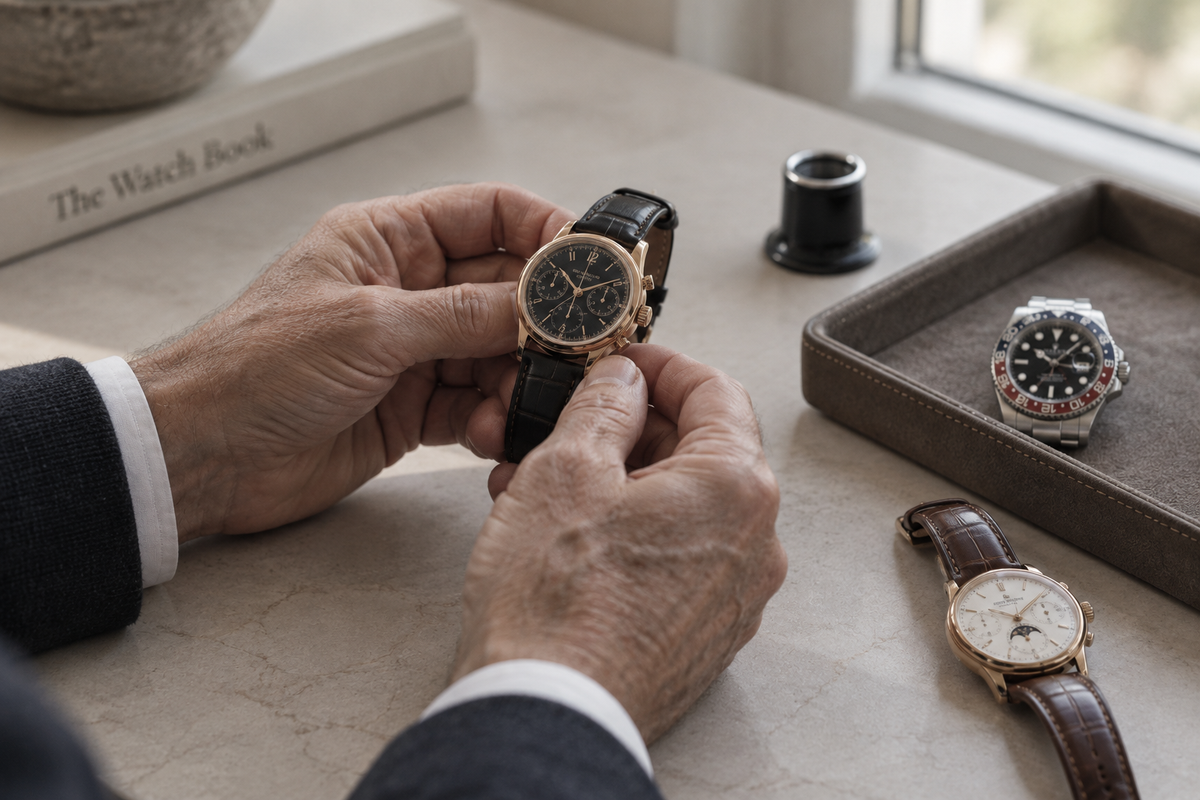
When a Watch Collection Becomes Part of the Family Balance Sheet
A family office records portfolios, companies, property and private-market holdings in detail while a multimillion-franc watch collection remains outside the consolidated wealth report. The watches sit in safes, move between residences or stay with individual family members, often without a current valuation or central ownership record. At that scale, valuation, liquidity, insurance and succession belong in the family’s financial records.
The secondary market has become large enough to make the omission harder to defend. EveryWatch data published in Chrono Passion put global secondary-watch sales at $10.5 billion in the first half of 2026, 37.2 percent above the same period a year earlier. Around 795’000 watches changed hands, up 18.7 percent, while the median selling price rose 19.3 percent to approximately $5’900. Transaction value therefore grew roughly twice as fast as the number of watches sold.
For a family office, market size solves only one part of the problem. A watch does not enter a consolidated balance sheet in the same way as an exchange-traded security. There is no single closing price. Condition, provenance, original papers, service history, rarity and the sales channel all affect what a buyer will pay. Auction results provide evidence for rare pieces; dealer transactions give a better picture for watches that trade regularly; manufacturer-backed certified pre-owned programmes add another price layer.
A market price is not the same as cash
EveryWatch recorded a turnover rate of 55 percent in H1 2026, compared with 46 percent a year earlier. More than half of the watches offered for sale therefore found buyers. Yet median time to sell increased from 39 to 43 days. A larger share of inventory sold, but owners waited slightly longer for a transaction.
Individual models show why a family office needs more than an estimated market value. Tudor Black Bay watches recorded a turnover rate of 95 percent in the report, while Rolex GMT-Master and Submariner reached 89 and 88 percent respectively. A watch worth CHF 30’000 with a deep international buyer base may therefore provide easier liquidity than a six-figure reference for which only a small group of collectors is prepared to bid.
A consolidated report should separate those two characteristics. Value answers what the asset appears to be worth; liquidity answers how readily the family could realise that value. Recording only an auction estimate or dealer quotation gives the family an incomplete picture of both.
The brand name tells only part of the valuation story
Rolex accounted for approximately 41 percent of global secondary-market value in the EveryWatch data, almost three times Patek Philippe’s 14.4 percent share. Daytona generated around $962 million of transactions during the first half, Datejust approximately $940 million and GMT-Master II $466 million.
Brand-level averages still hide large differences between individual references. EveryWatch measured average secondary-market value at 75.4 percent above retail for Patek Philippe, 35.7 percent for Audemars Piguet and 6.1 percent for Rolex. Using a different measure, however, approximately 75.8 percent of the Rolex references analysed traded above retail, compared with 67.9 percent for Audemars Piguet and around 52 percent for Patek Philippe.
A family office valuing ten watches therefore gains little from writing “Rolex collection — CHF 500’000” beside one line in the asset register. Each reference needs its own valuation basis. The family also needs to know whether the figure comes from an asking price, a completed dealer transaction, a recent comparable auction or an appraisal. Those numbers answer different questions.
Rarity introduces another problem. Independent watchmakers generated approximately $634 million of secondary-market transactions in H1 2026, up 89 percent year on year. F.P. Journe alone produced more than $201 million of value from only 608 watches sold, with a median price of $215’000. A few transactions can therefore move observable prices far more than they would in a market with thousands of comparable pieces.
Auction records require context
Auctions generated around $680 million in H1 2026, up from $469 million a year earlier. Seventy-three lots exceeded $1 million, compared with 26 during the same period in 2025, and three watches sold for more than $10 million. An F.P. Journe Chronomètre à Résonance reached approximately $13.9 million; two Patek Philippe watches followed at just above $10 million each.
Such sales establish evidence for rare pieces, but they do not turn every comparable watch into an asset worth the same amount. Auction houses sell individual objects whose condition, provenance and scarcity differ, sometimes materially. A record price therefore belongs in a valuation file together with the characteristics that made the comparison credible.
The magazine contains repeated examples. A Patek Philippe reference 5959R-001, limited to 15 pieces and offered with its original documentation, sold at Christie’s for $571’500. A 1951 pink-gold Patek Philippe reference 2499 carried British hallmarks and extensive provenance, attributes that formed part of its collector value rather than merely describing the watch. A Rolex Daytona “Paul Newman” from around 1967, preserved within the original owner’s family for more than 45 years, sold for CHF 1’151’999.
A family office that owns comparable pieces needs to preserve the evidence as carefully as the watches themselves.
Geography changes the exit price and the time required
A watch collection may sit in Switzerland while its natural buyer sits in New York, Hong Kong or Dubai. EveryWatch recorded approximately $4.5 billion of transactions in the United States and Canada during H1 2026, up 70 percent, with a median selling price of about $8’900 and a median selling time of 35 days. Europe generated $4.02 billion, but watches took a median 58 days to sell and the median transaction price was around $4’940. Asia recorded $1.48 billion and the shortest selling time at 26 days.
A valuation prepared for internal reporting therefore needs a likely market as well as a number. The price achievable through a European dealer, an international auction house and a private sale to a specialist collector will not necessarily match. Selling costs and timing also belong in the liquidity assessment if the family expects the asset to fund another obligation.
Manufacturer-backed resale adds another channel. EveryWatch estimated Rolex Certified Pre-Owned sales at approximately $385 million during H1 2026. Certified pre-owned programmes move authentication, warranty and dealer backing into the resale transaction, giving buyers another reason to pay different prices for otherwise comparable references.
The collection needs its own asset register
The first job for a family office is inventory rather than investment analysis. Each watch needs a reference number, serial information where appropriate, purchase history, current location, ownership, supporting papers, service records, photographs and insurance details. The valuation date and method belong beside the estimated value.
The office can then classify the collection by liquidity. A regularly traded Rolex with hundreds of observable transactions belongs in a different category from a rare independent watch whose market consists largely of private collectors and occasional auctions. A third category may contain watches whose emotional or family value makes a sale unlikely regardless of price. A consolidated report can show all three without pretending they behave like the same asset.
Insurance also depends on current records. A policy agreed several years earlier may no longer correspond to the value of a collection whose individual references have moved sharply. Storage arrangements matter for the same reason. The family office needs to know where each piece is held, who has access and whether the documentation required for a future sale remains with the watch or somewhere else.
Succession exposes what the balance sheet ignored
Watches become harder to treat informally when ownership passes from one generation to another. A portfolio of securities divides mathematically. A collection does not. One heir may want the watches, another may prefer cash, while a third may attach family history to individual pieces.
A current inventory and defensible valuation give the family numbers before those decisions become urgent. They also identify which pieces carry exceptional provenance or documentation that an executor or heir might otherwise overlook. Selling a rare watch without understanding those attributes can destroy value before the family discovers what it owned.
Collectors now have far more information than they did a decade ago. EveryWatch tracks realised prices, asking prices, transaction volumes, turnover and selling times across markets. Better market data does not turn a watch into a listed security. It gives a family office enough evidence to stop treating a material collection as an invisible asset.
FIVE QUESTIONS FOR A FAMILY WITH A MATERIAL WATCH COLLECTION
Is every watch recorded?
The inventory needs ownership, reference, location, documentation and purchase history rather than a single estimated value for the collection.
When was each piece last valued?
Use evidence appropriate to the watch: completed transactions for liquid references, specialist appraisals and comparable auctions for scarcer pieces.
How quickly could it actually be sold?
Record liquidity separately from valuation. A high price does not guarantee a broad buyer base.
Are insurance and custody based on current information?
Market values move, watches move between locations and documentation can become separated from the asset.
What happens to the collection when ownership changes?
Decide which pieces have family significance, which heirs want them and which watches the family is prepared to sell before succession forces the decision.