
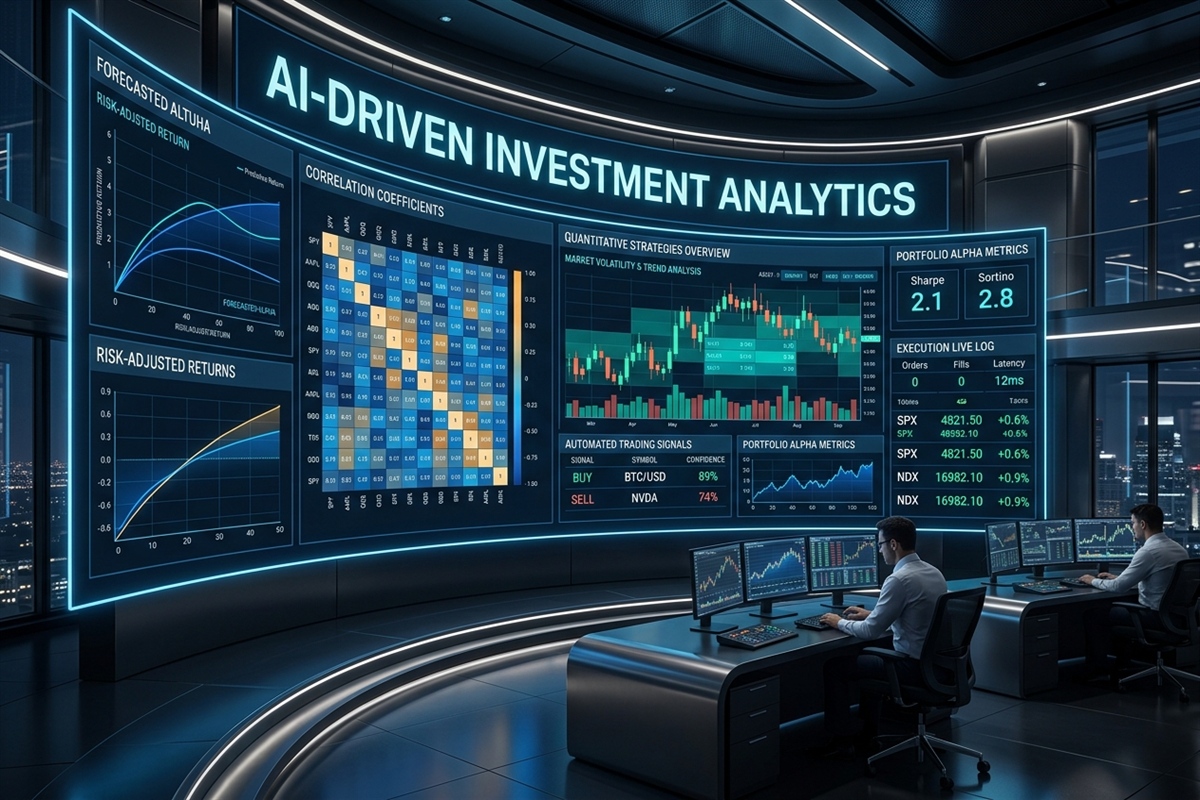
AI-Driven Investment Analytics
Artificial intelligence is changing investment analytics from a supporting function into a core component of portfolio management. Faster data processing, lower operating costs and more personalised advice are attracting substantial investment. But the competitive advantage will not come from algorithms alone. It will depend on the quality of firms’ data, governance and human oversight.
Artificial intelligence is becoming embedded in the machinery of wealth management. Global investment in AI technologies rose by 40% in 2022, reflecting financial institutions’ growing reliance on data-driven decision-making.
For investment managers, the appeal is straightforward. AI systems can process large and varied datasets at speeds beyond the capacity of human analysts, identify patterns across markets and update forecasts as new information becomes available. What began as an efficiency tool is increasingly shaping asset allocation, risk management and client advice.
The shift is not simply a technological upgrade. It changes how investment decisions are prepared, tested and executed.
From statistical models to adaptive systems
Investment analytics have long combined statistical modelling with professional judgement. Portfolio managers relied on historical data, conventional risk measures and their own interpretation of market conditions.
Machine-learning systems extend this process. They can analyse structured financial data alongside less conventional sources, identify relationships that may not be visible through traditional models and adjust their outputs as market conditions change.
Predictive analytics are one prominent application. By processing a wider range of variables, AI models can help firms detect changes in market momentum, credit quality or portfolio risk earlier than conventional systems.
BlackRock, for example, has implemented AI-driven models that reportedly improved forecasting accuracy by 20%, allowing the asset manager to refine its risk-management processes. Goldman Sachs and Morgan Stanley have also invested heavily in AI as they seek to strengthen their analytical capabilities and preserve a competitive advantage.
The growing complexity of global financial markets is accelerating adoption. As portfolios incorporate more asset classes, currencies, jurisdictions and private-market exposures, the volume of information required for effective oversight continues to increase.
Capital follows the technology
Investment in AI technology was projected to exceed $98 billion globally by 2023. Financial services are an important part of that expansion, driven by demand for faster analysis, lower costs and more personalised investment services.
Around 55% of financial-services firms have incorporated AI into at least part of their operations. Firms that have fully integrated such systems report operating-cost reductions of approximately 20%.
Speed is another selling point. AI-driven platforms can process certain datasets up to 1,000 times faster than traditional methods. In markets where new information can alter valuations within seconds, the ability to analyse data rapidly can materially affect investment decisions.
Demand is also coming from clients. Interest in AI-enhanced financial services has risen by 30%, as investors seek portfolios and advice tailored more closely to their objectives, risk tolerance and liquidity needs.
These figures point to a broader transition. AI is moving beyond isolated pilot projects and becoming part of the underlying infrastructure of investment management.
More insight, not automatic certainty
The advantages of AI are substantial, but they should not be confused with certainty. An algorithm may identify correlations that a human analyst overlooks, yet its conclusions remain dependent on the quality, relevance and completeness of the underlying data.
Dr Jane Thompson, an AI specialist at Cambridge University, describes the integration of AI into investment analytics as a necessity for navigating increasingly complex financial markets.
John Smith, chief executive of a fintech company, argues that AI offers a strategic advantage by revealing patterns and trends that are difficult for human analysts to detect.
Financial analyst Sarah Johnson highlights a different consequence: the technology may broaden access to sophisticated investment tools. Smaller firms can increasingly use analytical capabilities that were once available mainly to large banks and asset managers with extensive technology budgets.
This democratisation, however, may be temporary. As basic AI tools become widely available, differentiation will shift towards proprietary data, system integration and the ability to translate automated outputs into sound investment decisions.
The implementation gap
For wealth managers, the central question is no longer whether AI will influence investment analytics. It is whether institutions can integrate the technology without weakening accountability or introducing new forms of risk.
Successful implementation requires more than purchasing software. Firms need reliable data architectures, clear governance and employees capable of interpreting model outputs. They must also understand when an AI-generated recommendation should be challenged or rejected.
Four priorities stand out.
First, firms need a coherent data-management strategy. Fragmented, outdated or inconsistent information will undermine even the most advanced analytical model.
Second, employees require training not only in using AI tools but also in assessing their limitations. Investment professionals must remain able to explain the reasoning behind portfolio decisions to clients, regulators and internal risk committees.
Third, AI systems require continuous monitoring. Models trained on historical relationships may become less reliable when market structures, regulations or investor behaviour change.
Finally, firms should define clear lines of responsibility. AI can support a decision, but it cannot assume fiduciary or regulatory accountability for that decision.
A test of institutional capability
Over the next three to five years, AI-driven analytics are likely to become a standard feature of investment platforms. PwC estimates that AI could contribute as much as $15.7 trillion to the global economy by 2030, with financial services among the sectors most affected.
The likely result is not the replacement of investment professionals, but a redistribution of their work. Less time may be spent collecting and reconciling information, while more attention is directed towards interpreting results, questioning assumptions and communicating decisions to clients.
The largest institutions may benefit from scale, proprietary datasets and substantial technology budgets. Smaller firms, meanwhile, may gain access to analytical tools that allow them to compete more effectively in specialised markets.
Yet technology alone will not determine the winners. As AI becomes commonplace, the decisive advantage will lie in implementation: clean data, robust controls, skilled employees and a clear understanding of where automated analysis ends and human judgement must begin.