
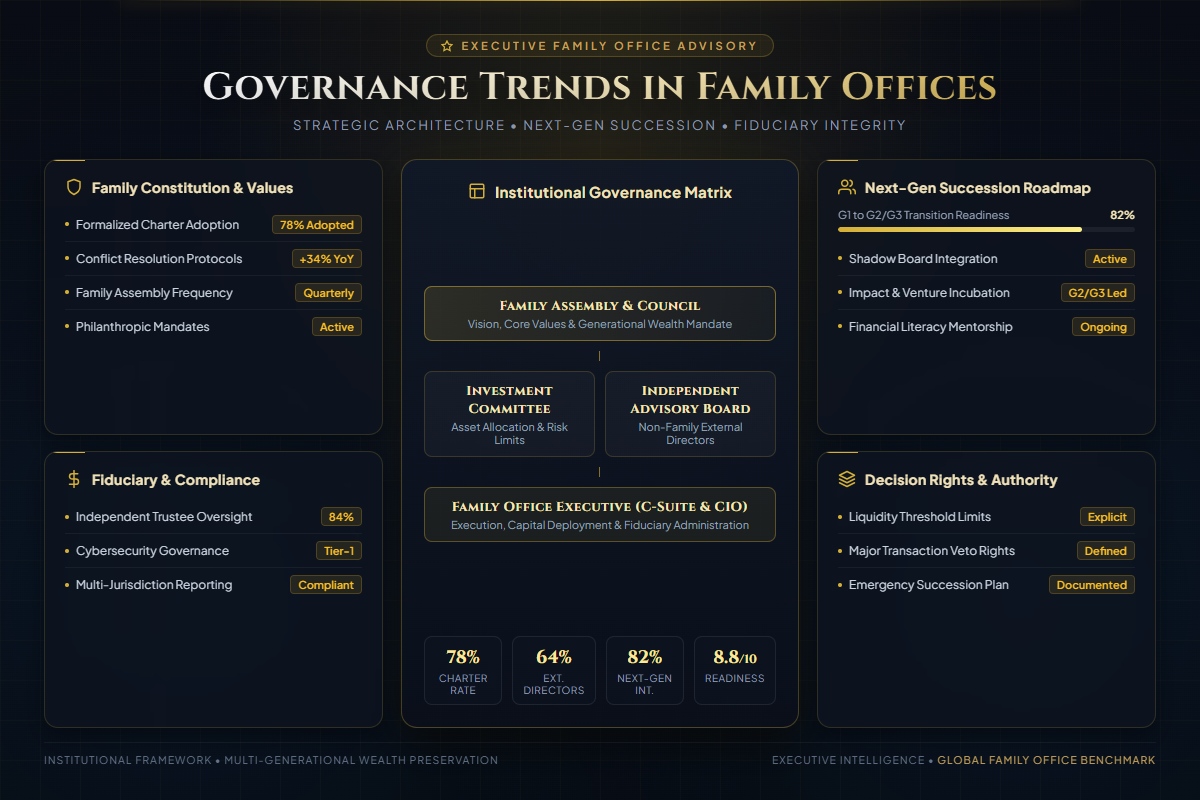
Governance Trends in Family Offices
Wealth can be created by one generation. Preserving it usually requires something else: governance.
That is the lesson many family offices are now learning. As private wealth becomes more global, more diversified and more exposed to regulation, informal decision-making is becoming harder to sustain. The family office is no longer just an administrative centre for investments, tax and estate planning. Increasingly, it is the institution through which families organise power, responsibility and continuity.
This matters because family offices now oversee vast pools of private capital. Estimates vary, but their collective assets are commonly measured in the trillions of dollars. The sector has become too large, too sophisticated and too visible to rely on personal trust alone.
The End of the Informal Model
For much of their history, family offices were built around discretion. A founder, patriarch or small circle of trusted advisers made the key decisions. Structures were often light. Documentation was limited. Authority was personal.
That model had advantages. It allowed speed, privacy and flexibility. It also suited families whose wealth was concentrated in one operating business or one domestic market.
But wealth rarely stays simple. Businesses are sold. Assets move offshore. Children study abroad. Portfolios expand into private equity, venture capital, real estate, hedge funds, philanthropy and impact investing. External advisers multiply. Tax and reporting obligations become more demanding.
At that point, informality becomes a risk.
Poor governance can produce slow decisions, family disputes, unclear authority, weak oversight and inconsistent investment discipline. It can also leave the family vulnerable when the founder is no longer able to act as the final decision-maker.
Governance Is More Than Administration
In a corporate context, governance is often associated with boards, controls and compliance. In a family office, the meaning is broader.
It includes the rules by which the family makes decisions. It defines who has authority over investments, distributions, philanthropy, operating businesses and succession. It clarifies the role of family members, external advisers and professional staff. It also protects the family office from becoming a battlefield for unresolved personal tensions.
Good governance does not remove emotion from family wealth. That would be impossible. It creates structures that prevent emotion from dominating every decision.
This is why formal boards, investment committees, family councils and written policies are becoming more common. They help turn wealth from a private possession into a managed institution.
The Rockefeller Lesson
The Rockefeller family is often cited as an early example of structured family-office governance. Its approach combined investment management, philanthropy, education and long-term stewardship. The lesson is not that every family should copy the Rockefeller model. Few can, and fewer should.
The more useful lesson is that large family wealth needs architecture. Without it, complexity accumulates. With it, values, capital and decision-making can survive beyond the founder generation.
Modern family offices face a similar challenge, but under more demanding conditions. The investment universe is broader, regulation is tighter, families are more geographically dispersed and reputational risk travels faster.
Succession Is the Hardest Governance Test
Succession planning is where weak governance becomes most visible.
Many families avoid the topic because it is sensitive. Founders may not want to surrender control. Heirs may not be ready to assume responsibility. Family members may disagree about risk, spending, philanthropy or the future of the operating business.
Avoidance is costly. When succession is left unclear, wealth can become a source of conflict rather than security.
A serious governance model should therefore define leadership transition early. It should address voting rights, ownership structures, family employment, education, liquidity needs and dispute resolution. It should also prepare the next generation to understand not only the assets, but the responsibilities attached to them.
The goal is not to freeze the family into one model forever. It is to create a framework that can absorb change without collapsing into conflict.
The Next Generation Wants a Voice
Younger family members are changing the governance debate. Many expect more transparency, stronger reporting and a clearer link between wealth and purpose. They are often more interested in sustainability, venture capital, technology, philanthropy and impact investing than the generation that built the wealth.
This can create tension. Founders may view these priorities as fashionable or risky. Younger heirs may see the old model as opaque or overly conservative.
Governance can turn that tension into a productive conversation. Family councils, education programmes and structured investment committees give younger members a channel to participate without forcing an abrupt transfer of control.
This is especially important in families where ownership is shared but authority remains concentrated. Without participation, the next generation may inherit assets without understanding them.
Technology Raises the Standard
Digital transformation is changing what families expect from their offices. Consolidated reporting, secure document management, portfolio analytics, cybersecurity and real-time access to information are becoming basic requirements.
A family office that still relies heavily on fragmented spreadsheets and scattered bank reports is exposed. It may not have a clear view of total wealth, liquidity, fees, risk concentration or private-market exposure.
Technology does not solve governance by itself. But it makes weak governance harder to hide.
Better data supports better oversight. It allows investment committees to challenge assumptions, family members to understand the portfolio and principals to see whether the office is delivering on its mandate.
For complex families, transparency is no longer a courtesy. It is a control mechanism.
Cybersecurity Becomes a Governance Issue
Cybersecurity is often treated as a technical matter. In family offices, it is also a governance issue.
Family offices hold sensitive information: asset structures, legal documents, tax records, investment reports, identity documents, family communications and sometimes personal security details. That makes them attractive targets.
A breach can cause financial loss, reputational damage and personal exposure. The risk is particularly high because some family offices combine institutional-scale wealth with relatively small operational teams.
Governance should therefore include clear policies on access rights, data storage, external providers, device security, incident response and staff training. Cybersecurity cannot be delegated entirely to an IT vendor. It belongs on the family-office risk agenda.
External Advisers Need Oversight
Family offices depend on external experts: lawyers, tax advisers, private bankers, investment consultants, trustees, accountants and technology providers. Their advice can be valuable. Their incentives, however, are not always identical to the family’s interests.
A strong governance model defines how advisers are selected, monitored and paid. It also prevents the family from becoming dependent on one dominant relationship.
This is particularly important when portfolios are complex or cross-border. The family office should be able to coordinate advisers, compare recommendations and challenge conflicts of interest.
Independence is not a slogan. It is a process.
What a Strong Governance Model Should Include
A mature family-office governance model should answer several practical questions.
Who has authority to make investment decisions? Which decisions require family approval? How are family members informed? What is the role of external advisers? How are conflicts resolved? Who supervises the family-office team? How is performance measured? What happens when leadership changes?
The answers do not have to be complicated. In fact, excessive bureaucracy can weaken a family office. The best structures are clear, proportionate and usable.
For many families, the core elements include an investment policy statement, a family constitution, a succession plan, defined reporting standards, a family council, an investment committee and a regular review of advisers and service providers.
The purpose is not to imitate a public company. It is to protect private wealth from private disorder.
Governance as Competitive Advantage
Family offices that govern themselves well are likely to have an advantage. They can make decisions faster because authority is clear. They can manage risk better because reporting is stronger. They can retain advisers more effectively because roles are defined. They can survive succession because the office is not dependent on one person.
The reverse is also true. A family office with unclear governance may still perform well in favourable markets. But when markets fall, heirs disagree, regulation tightens or liquidity becomes scarce, weaknesses appear quickly.
Governance rarely looks urgent when things are going well. Its value becomes obvious when they are not.
From Wealth Preservation to Institutional Discipline
The transformation of family-office governance reflects a larger shift in private wealth. Families are moving from wealth preservation towards institutional discipline.
That does not mean becoming impersonal or bureaucratic. The best family offices remain deeply shaped by the family’s history, values and ambitions. But they combine that identity with clearer structures, better data and stronger accountability.
Over the next few years, governance will become one of the main dividing lines in the family-office sector. Families with robust frameworks will be better prepared for succession, regulation, cyber risk and complex global portfolios. Those that rely on informal authority may find that the old model no longer protects them.
In the end, governance is not about reducing family control. It is about making control sustainable.