The Luxury Property Market Is Splitting Between Ordinary and Exceptional Homes
Swiss residential prices continue to rise, but the forces behind a family apartment in Zurich and a chalet in St Moritz are becoming harder to compare. Financing requirements restrict ordinary buyers, while international wealth and a shortage of exceptional properties support prices in selected luxury markets.
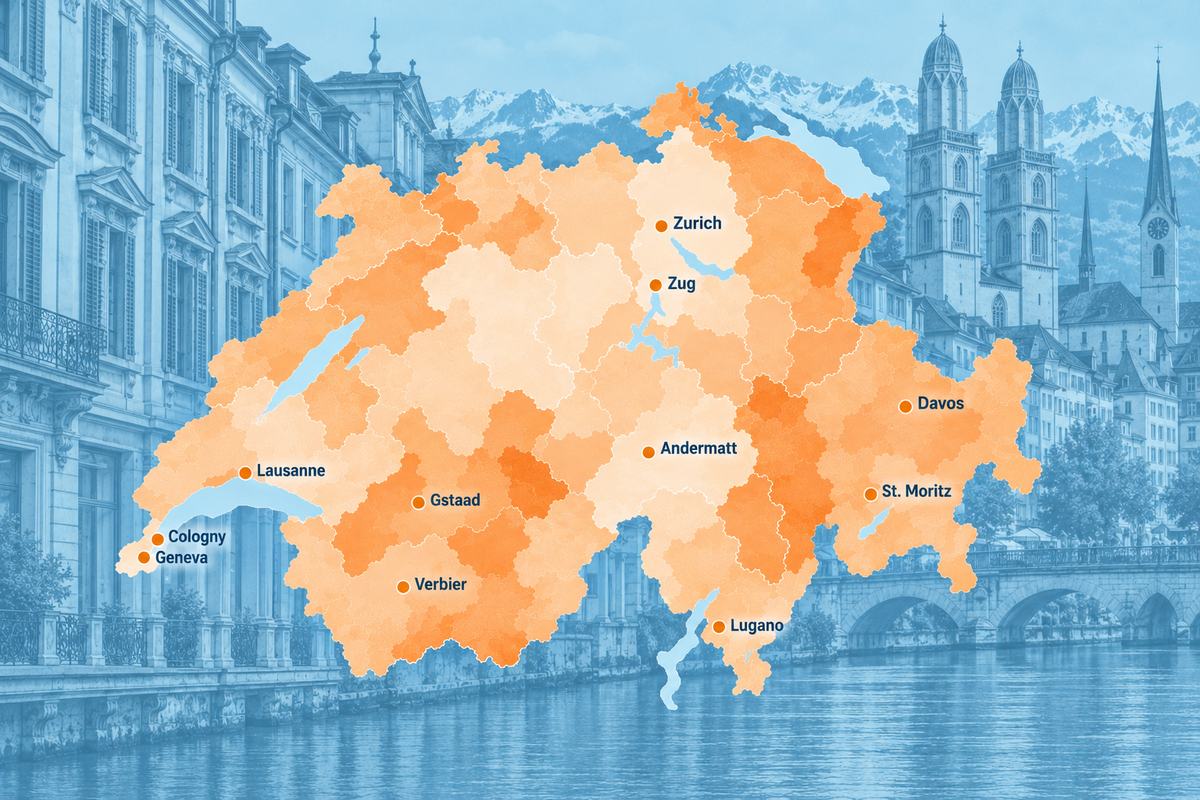
In St Moritz, luxury residential property now costs an average of approximately CHF 52’000 per square metre. Gstaad and Verbier follow at around CHF 45’000, while Cologny, on the shores of Lake Geneva, leads the market for primary residences at CHF 43’000. A 150-square-metre apartment in one of Switzerland’s prestigious residential municipalities typically commands CHF 4–5 million, according to UBS.
The prices have climbed despite a cooling in the wider luxury market. Across 31 leading Swiss locations, UBS recorded growth of slightly more than three percent in 2025, below the increase in the broader owner-occupied housing market. Alpine luxury homes gained six percent, however, extending a five-year rise of approximately 40 percent in the mountain regions. Affluent international buyers supplied much of the demand.
The figures reveal a property market dividing along several lines. Ordinary buyers must qualify for mortgages against incomes that have failed to keep pace with house prices. Wealthy purchasers can draw on accumulated capital, business proceeds and investment portfolios, although they too have become more selective about what they will pay. Within the luxury segment, prestigious addresses, the availability of suitable homes and the circumstances of individual sellers are producing sharply different outcomes.
The Financing Constraint on Ordinary Homes
Swiss mortgage rates remain comparatively low after the Swiss National Bank kept its policy rate at zero percent on 24 September 2026. Affordable borrowing has supported residential property demand, although a low interest rate offers limited help to households whose income is insufficient to meet the banks’ affordability tests.
UBS calculates that Swiss house prices rose by an average of 3.2 percent annually over the past 15 years, while household incomes increased by just one percent a year. Its 2026 property report found that a household earning the local median income could afford a high-quality, 100-square-metre condominium in only 17 percent of Swiss municipalities. Those municipalities account for just seven percent of the country’s population.
Even when buyers lower their expectations to an average-priced property, the share of municipalities within reach rises only to 34 percent. Around Zurich, Geneva and Lausanne, demand has consequently moved further into surrounding areas as households search for homes that meet bank lending requirements.
Banks assess the durability of mortgage payments against longer-term borrowing costs, not merely the interest charged at the time of purchase. Buyers also need sufficient equity and must account for maintenance and amortisation. A household with a good salary can consequently find that the property it wants remains beyond reach, even when current mortgage payments appear manageable.
The same constraints operate differently at the top of the market. High-net-worth purchasers can contribute more equity, use other assets to support financing or dispense with a mortgage when their liquidity permits. A buyer acquiring a CHF 10 million residence from the proceeds of a business sale has a different exposure to financing costs from a household purchasing a CHF 1.5 million apartment with the minimum required equity.
Cash purchases and low leverage reduce dependence on mortgage approval, although they do not establish what a property is worth or guarantee that another wealthy buyer will pay the same price. A larger equity contribution also ties up capital that the owner might otherwise invest elsewhere.
Scarcity Has Become a Local Affair
Switzerland’s luxury market contains several groups of buyers whose wealth, mobility and reasons for purchasing differ. The distinction is apparent between Zurich and Zug, where employment, taxation and international business influence primary-home demand, and the Alpine resorts, where holiday ownership forms a substantial part of the market.
UBS found that weaker employment growth around Zurich dampened luxury demand in 2025, whereas the Zug region retained momentum. Asking prices were also coming under greater scrutiny when properties reached the transaction stage. The bank expects buyers’ willingness to pay for luxury homes in the wider Zurich region to stagnate amid weaker economic conditions.
The Lake Geneva market has developed differently. Cologny remains the most expensive primary-residence location identified by UBS, followed by other prestigious addresses around Geneva and the lake. International business, commodity trading and demand from wealthy households relocating to the region support the market. UBS expects somewhat stronger interest from the Middle East, although recent price increases around Lake Geneva have generally lagged the national luxury average.
The limited supply of lakefront land and established residential neighbourhoods gives exceptional properties a degree of insulation from competition. A house with direct lake access, extensive grounds or an unobstructed view cannot readily be replaced by new development nearby. Buyers seeking a particular combination of privacy, location and architectural quality may therefore encounter very few suitable alternatives, even in municipalities containing numerous expensive homes.
Yet scarcity alone does not settle the price. Buyers still assess the building’s condition, renovation requirements, access, privacy and resale potential. A property offered at an ambitious price can remain unsold when comparable houses have more favourable characteristics, while an exceptional residence attracts interest because of features that are difficult to reproduce.
Ticino provides an example of the other side of this market. UBS reported stagnant luxury prices in the southern canton in 2025 and prolonged selling periods. Owners who need to complete a transaction quickly may have to accept discounts despite continued demand from affluent newcomers from Italy and support from Lugano’s financial sector.
The same country, currency and broadly favourable interest-rate environment have therefore produced strong Alpine gains, a slowing Zurich market and much weaker pricing conditions in Ticino.
Mountain Properties Follow a Different Market
Switzerland’s Alpine resorts have benefited from a combination of international demand and restrictions on the creation of new holiday homes. The federal Second Homes Act generally prevents the construction of additional second residences in municipalities where such properties already account for more than 20 percent of the housing stock, subject to statutory exceptions.
The Federal Office for Spatial Development reported in March 2026 that 331 Swiss municipalities exceeded that threshold, many of them in Alpine regions. Restrictions on new development make existing properties with unrestricted second-home use attractive to purchasers seeking a holiday residence, although their legal status must be checked individually.
The effect becomes apparent in resorts where the available stock already commands high prices. Owners have fewer opportunities to replace an older chalet with a newly constructed alternative, and buyers must compete for properties that meet their requirements for size, location and permitted use. Renovation can improve the standard of the existing stock, but does not necessarily create more homes available to the market.
Foreign demand introduces another influence. Swiss resorts attract buyers whose primary income and wealth may be generated outside Switzerland, reducing the extent to which local employment and Swiss household affordability explain prices. Such purchasers are often seeking a second residence rather than accommodation near their workplace.
Knight Frank’s Alpine Report, published on 22 October 2026, found average prime mountain property prices increasing by 3.2 percent across its surveyed destinations. Davos and Andermatt recorded annual rises of 14.5 and 12.5 percent respectively, while Verbier gained 6.7 percent and St Moritz 3.7 percent.
The variation points to increasingly local price dynamics. Established resorts with exceptionally expensive properties still attract wealthy buyers, but their annual increases do not necessarily match those of destinations where infrastructure, development and changing purchaser preferences are influencing demand.
Some buyers also treat an Alpine residence as part of their family wealth rather than a conventional investment property. They may intend to retain the home across generations, accept periods without rental income and place considerable weight on privacy and continuity of ownership. These preferences can reduce the number of properties offered for sale, particularly in sought-after locations with limited replacement supply.
Foreign ownership remains subject to Swiss law. The Lex Koller framework restricts acquisitions by certain non-resident foreign buyers, and the rules vary according to residence status, property use and the applicable authorisation requirements. International interest cannot therefore be treated as an unrestricted pool of potential purchasers.
Where Price Growth Is No Longer Enough
The financial position of luxury homeowners is often stronger than that of buyers entering the housing market for the first time, but the investment performance of their properties depends on the price at which they can eventually sell.
Julius Baer’s first-quarter 2026 property report, drawing on Wüest Partner data, found that prices for premium Swiss single-family homes increased by 5.6 percent during 2025, slightly ahead of the 5.3 percent rise across the wider house market. Premium apartments gained 4.2 percent, compared with 4.5 percent in the middle segment. The figures support a more differentiated picture than the assumption that expensive property always outperforms.
The way researchers define a premium property also affects the results. The UBS luxury survey concentrates on 31 of Switzerland’s most exclusive locations, whereas broader studies include higher-priced properties across a much wider geographical area. A well-appointed villa in a regional market and a rare lakeside estate in Cologny can both belong to the luxury category while attracting entirely different purchasers.
Their valuations also respond to different constraints. Buildings requiring extensive renovations face construction costs, lengthy planning procedures and, in some locations, restrictions on redevelopment. Buyers willing to undertake such work may demand a reduction from the seller’s asking price. Fully renovated properties in desirable locations can command premiums, although the amount recovered from improvements depends on whether subsequent purchasers share the owner’s preferences.
The annual cost of ownership deserves attention alongside changes in market value. Maintenance, insurance, cantonal and communal property-related taxes, potential financing expenses and major renovations affect the return on a residence that generates little or no rental income. A holiday home occupied only for part of the year carries these costs throughout the year.
Higher borrowing costs can also affect sellers who are not themselves dependent on mortgages. A buyer financing part of a transaction will calculate what the property costs to own, while investors comparing real estate with bonds or other assets will reassess the return they require. The SNB’s zero-percent policy rate provides a favourable domestic backdrop in October 2026, though longer-term mortgage rates and individual credit terms do not move in exact proportion to the policy rate.
The Price of an Exceptional Address
The purchasing power available in Switzerland’s leading luxury markets remains considerable. UBS estimates that the average price of luxury homes across the 31 locations it surveyed has risen by almost five percent annually over the past five years. Despite that growth, it expects the sector to underperform the wider residential market in 2026 as some buyers become more cautious about valuations.
Owners contemplating a sale face an additional problem: the exceptionally high prices attached to rare homes do not guarantee immediate liquidity. At the upper end of the market, there are fewer purchasers able and willing to complete a transaction. The eventual price depends on finding someone who wants that particular property and can satisfy any financing and ownership requirements.
This becomes especially consequential when a family needs to realise capital following an inheritance, divorce, business restructuring or change of residence. A valuation based on comparable properties provides a starting point, while the proceeds available within a fixed period can be lower if the seller has limited time to negotiate.
The Swiss markets most exposed to internationally mobile wealth have continued to command remarkable prices, but the differences between them are growing. Around Zurich, the strength of employment and the purchasing power of expatriate households influence demand. Geneva’s luxury market draws on international business and relocating families. Zug benefits from its concentration of companies and wealthy residents, while Alpine resorts combine restricted supply with buyers whose attachment to a property often extends beyond its annual financial return.
Private wealth owners also face a portfolio question when a residence appreciates substantially. A property originally purchased as a family home can become one of the largest individual assets on the balance sheet, with its value concentrated in a single location and its proceeds inaccessible without borrowing against it or selling it.
How much a family can rely on that value depends partly on its willingness to sell, the number of suitable buyers and the time available to complete a transaction. Owners of exceptional homes can command extraordinary prices when demand and scarcity coincide. They remain exposed to the circumstances of the next purchaser when the property eventually returns to the market.
Switzerland’s luxury residential market requires a property-by-property assessment. Strong historical price growth offers limited guidance to the time and proceeds involved in a future sale.
Local transaction evidence
Compare recent sales of properties with similar locations, land, condition and permitted use. Broad luxury-market averages can conceal large differences within the same municipality.
Financing and available capital
Assess the property’s value alongside the owner’s mortgage, other investments and future liquidity needs. A low loan-to-value ratio does not make the property immediately saleable.
Second-home restrictions
Verify the legal status of Alpine holiday properties and any limitations on rebuilding, conversion or ownership before purchasing.
Renovation commitments
Include major repairs, energy improvements, planning approvals and ongoing maintenance in the total cost of ownership.
Future sale conditions
Examine the likely pool of purchasers, foreign-buyer restrictions and the holding period available if family circumstances change.