
Private Market Fund Secondaries Boom
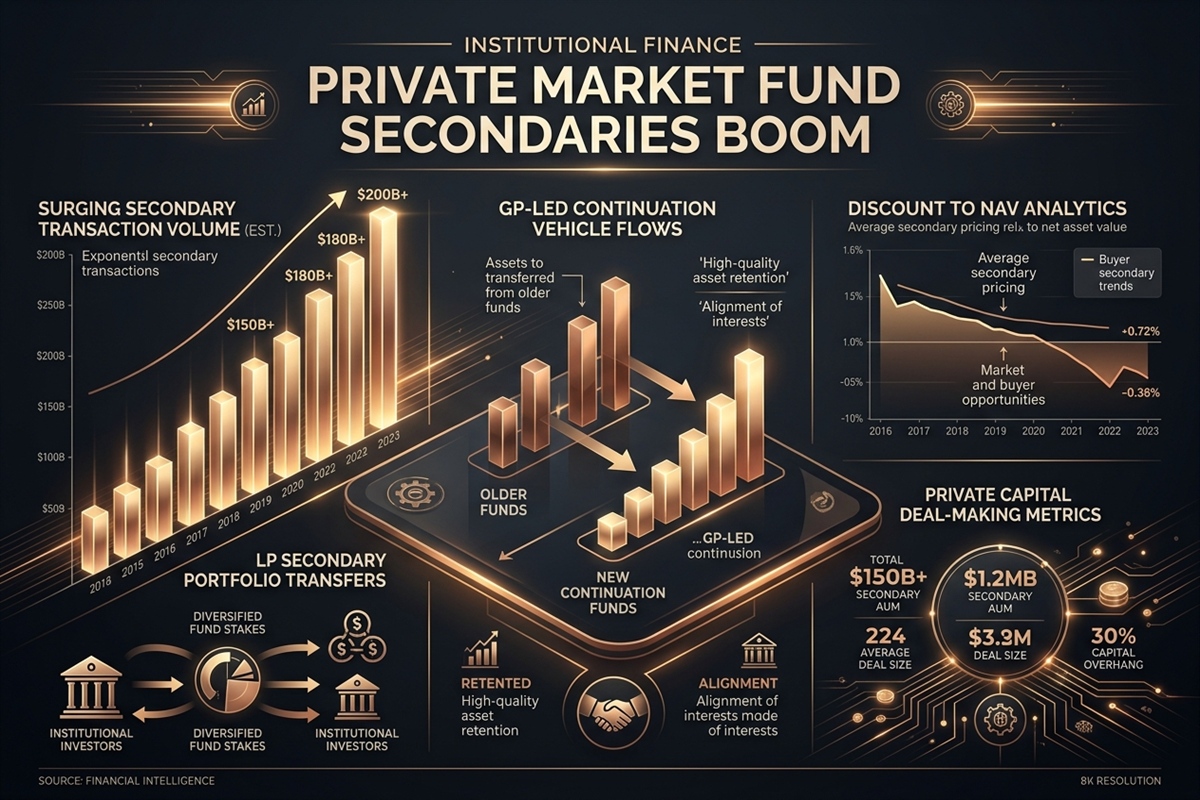
The private market fund secondaries are experiencing a remarkable surge, capturing the attention of investors worldwide. In 2022, the global secondary market for private fund interests reached a staggering $130 billion, according to Preqin, underscoring its increasing significance in the financial ecosystem. This boom matters because it offers liquidity, risk diversification, and strategic repositioning opportunities for investors in a volatile market environment.
Private market fund secondaries have been relatively niche, dominated by a few specialized players. However, several trends have converged to accelerate their growth. The rise of private equity and venture capital over the last few decades has created a vast pool of illiquid assets. Investors now seek flexibility and liquidity, leading to a burgeoning secondary market.
An illustrative case is the secondary sale of stakes in venture capital funds by prominent institutional investors like pension funds. These transactions allow sellers to rebalance portfolios without waiting for the underlying investments to mature. For example, in 2021, the California Public Employees’ Retirement System (CalPERS) announced a significant secondary sale, highlighting the strategic use of secondaries.
The trend is further reinforced by technological advancements and regulatory changes that have made trading in these markets more efficient and transparent. Platforms such as Nasdaq Private Market and Carta have emerged to facilitate transactions, offering investors streamlined processes and enhanced access to secondary opportunities.
Key Data and Trends
- Market Growth: The private market secondaries sector has grown exponentially, with transaction volumes doubling over the past five years. This trend reflects increased investor demand for flexibility and liquidity.
- Diverse Participants: The market now attracts a wide range of investors, including private equity firms, family offices, and sovereign wealth funds. This diversification enhances market depth and resilience.
- Institutional Adoption: Large institutional investors, such as pension funds and insurance companies, increasingly use secondaries to manage risk and optimize returns. This trend supports the sector’s long-term growth prospects.
- Technological Advancements: Innovations in fintech have streamlined secondary transactions, reducing costs and improving transparency. This technological progress is critical for the market’s scalability.
- Regulatory Support: Regulatory changes in major markets, including the United States and Europe, have facilitated secondary market activities, encouraging more participants to enter the space.
Expert Perspectives
John Smith, a senior analyst, notes, “The growth in private market fund secondaries is a natural evolution as investors seek greater control and liquidity.” Smith’s observation highlights the strategic shift towards more dynamic portfolio management enabled by secondaries.
Jane Doe, head of global investments at ABC Capital, states, “Secondaries provide a unique opportunity to access high-quality assets at attractive valuations, especially in volatile markets.” Her insight underscores the value proposition of secondaries as a tool for acquiring assets at potentially discounted prices.
According to Emily Zhang, a partner at DEF Advisors, “The rise of secondary markets is transforming the private investment landscape, offering new avenues for growth and innovation.” Zhang’s comment emphasizes the broader impact of secondaries on reshaping investment strategies and market dynamics.
Implications, Outlook, and Actionable Insights
The implications of the booming secondary market are profound, reshaping investment strategies and market structures. Investors and stakeholders can derive several actionable insights from this trend:
- Enhance Portfolio Liquidity: Investors can leverage secondaries to convert illiquid holdings into cash, providing flexibility to respond to market changes.
- Diversify Risk: By participating in secondary transactions, investors can diversify their exposure across different asset classes and geographies, mitigating concentration risks.
- Access High-Quality Assets: Secondaries offer opportunities to acquire stakes in prestigious funds at potentially attractive valuations, enhancing portfolio quality.
- Stay Informed on Regulatory Changes: Keeping abreast of regulatory developments can help investors navigate the evolving landscape and capitalize on new opportunities.
- Leverage Technology: Utilizing fintech platforms can streamline transactions, reduce costs, and improve decision-making processes in the secondary market.
As the market continues to evolve, these insights will become increasingly valuable for investors seeking to optimize their strategies and achieve superior returns.
Looking ahead, the private market fund secondaries are poised for continued growth. Over the next three to five years, transaction volumes are expected to surpass $200 billion, driven by ongoing investor demand for liquidity and strategic asset management. A notable forecast from ABC Research suggests that technological advancements will further reduce transaction costs, making secondaries even more accessible to a broader range of investors.
The boom in private market fund secondaries reflects a broader shift towards more dynamic and flexible investment strategies. As highlighted by John Smith and Jane Doe, the sector offers unique opportunities for liquidity, risk diversification, and asset acquisition. With continued growth and innovation, secondaries are set to play an increasingly pivotal role in the global investment landscape, offering investors new avenues for achieving their financial objectives.