
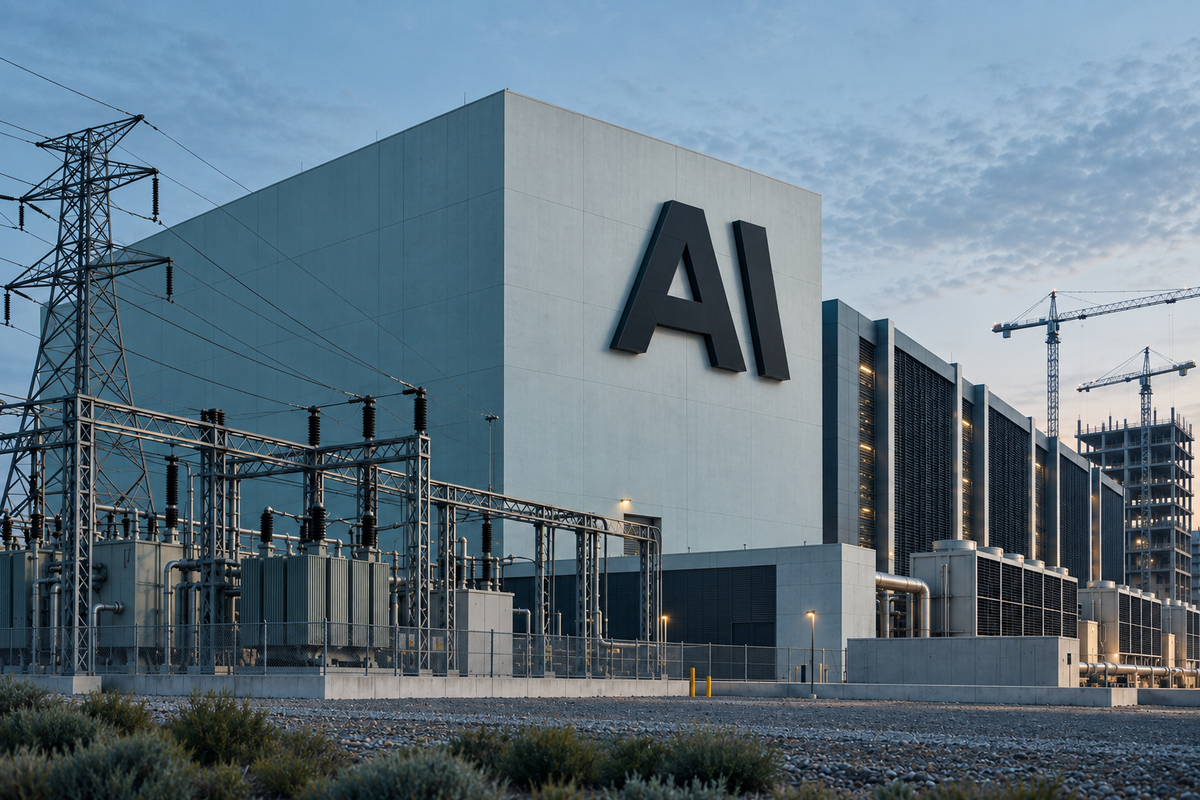
Where the AI Money Is Going
Your portfolio does not need a large technology allocation to be heavily exposed to artificial intelligence. The same AI build-out can appear through semiconductor shares, utilities, infrastructure funds, industrial companies and private credit — sometimes several times in the same portfolio. In 2026, following the money has become as important as following the technology.
Amazon expects capital expenditure of about US$220 billion in 2026, much of it directed at cloud and AI infrastructure. Meta expects US$135–145 billion. Across the largest data-centre operators, the International Energy Agency puts capital expenditure above US$700 billion this year. As those budgets move through the economy, they become revenue for chipmakers, construction groups, electrical-equipment suppliers, utilities and lenders long before the end customer has paid for an AI application.
Cloud groups buy processors and memory, lease or build data centres, secure electricity and order cooling, transformers and networking equipment. Their suppliers expand factories and construction capacity. Banks and private funds finance projects that exceed what some operators can fund from cash. The final customers arrive later, through cloud computing, software subscriptions, advertising and other services built on the capacity. A family portfolio can therefore hold several claims on the same spending cycle without owning several different investment themes.
The Money Reaches Suppliers First
Processors, memory and networking equipment take an early share because the computing has to exist before an AI service can be sold. Scarcity has spread beyond the best-known processors. The IEA expects shortages of high-bandwidth memory to persist at least through the end of 2027, while data-centre construction is adding to demand for transformers and other electrical equipment.
The supplier gets paid before the buyer has proved the return on the equipment. Cloud operators order servers, install them and begin depreciating them while customer revenue accumulates over subsequent years. Amazon says spending on a data centre starts roughly two years before servers are installed and revenue begins, yet the company still reports more demand for computing capacity than it can currently supply.
The building around those servers is absorbing almost as much attention as the chips themselves. Bank of America expects global data-centre spending to reach around US$1 trillion in 2026. New facilities require land, construction, cooling, backup systems, electrical equipment and a connection to the grid; larger AI sites also consume power on a scale once associated with industrial plants rather than office buildings.
Electricity consumption by data centres reached about 485 terawatt-hours in 2025, according to the IEA, and is expected to approach 950 TWh by 2030. Technology companies have responded with long-term power contracts and, where grid connections lag, investment in additional generation or on-site supply. Google’s agreement with Constellation Energy covers 3.59 gigawatts of nuclear power and supports additional output from existing reactors.
Cloud companies and data-centre developers are already paying chipmakers, contractors, electrical-equipment suppliers and utilities years before the software running on that infrastructure has proved its economics. Chipmakers are paid when equipment is delivered, contractors during construction and utilities once the power starts flowing, while infrastructure owners depend on occupancy and long-dated cash flows to recover their investment.
The Build-Out Is Drawing In More Lenders
The largest technology companies still generate enormous amounts of cash, but AI spending is beginning to change how parts of the industry finance themselves. Meta spent US$34.91 billion on capital expenditure in the third quarter alone while free cash flow turned negative for the period. Specialist cloud and AI businesses have much smaller existing earnings bases and rely more heavily on banks, bonds and private capital.
Bank of America, Citigroup and Morgan Stanley are arranging senior financing for US$63 billion of Broadcom equipment that Anthropic will use for AI computing, while Blackstone is providing junior capital. A special-purpose vehicle will buy the hardware and lease it to Anthropic, and Broadcom will carry part of the risk on its future value. The deal brings banks, private capital and the chip supplier into the same financing structure before Anthropic has earned the revenue needed to pay for the computing.
The structure distributes one AI investment across technology suppliers, commercial banks and private capital before reaching the company that will use the processors. A family office does not need to own Anthropic to participate in that risk. Exposure can sit in private credit, infrastructure, bank debt or the securities of the equipment supplier.
Financing also changes which projects survive when assumptions prove too generous. Cash-rich cloud groups can absorb periods of weak utilisation more easily than operators carrying large interest bills. A site with a long customer contract, secured electricity and committed financing sits in a different position from one built in anticipation of future demand.
That distinction is starting to appear in credit markets as AI-related borrowing grows. Lenders are assessing the customer behind each project, the length of contracts, the useful life of the equipment and the amount of debt the expected cash flow has to support. Chips lose value faster than data-centre buildings, while the economics of both depend on the computing capacity remaining occupied.
Power can stop a project before financing does. Grid connections, transformers and generation have become part of the construction timetable, and developers are competing for the same electrical infrastructure needed by manufacturing, transport and the rest of the economy. A large announced investment therefore says less than a project with a secured site, financing, customer and electricity supply.
Revenue Now Has To Catch Up With Investment
The strongest defence of the spending boom is that customers are already asking for more computing than some providers can supply. AWS revenue grew 37 percent in the second quarter while Amazon continued to report capacity constraints. Existing demand gives the company a stronger starting point for its investment than a developer building a data centre without committed tenants.
AI companies are also producing revenue at a pace that looked improbable only a few years ago. Anthropic reported US$16.29 billion for the first half of 2026, compared with US$4.59 billion for all of 2025. Its future infrastructure commitments, however, run into hundreds of billions of dollars.
Part of that spending flows back to companies that also finance or own stakes in the customer. Amazon and Google have invested in Anthropic while selling it computing capacity. Similar relationships are appearing elsewhere as chipmakers, cloud providers and AI developers secure customers, suppliers and capital from one another.
Accounts need to be read with those links in mind. Cloud revenue generated from an AI company remains revenue, but an investor also needs to know how that customer financed its spending and how concentrated the supplier’s demand has become.
The timing differs across the chain. A semiconductor company books revenue when it sells equipment. Contractors earn while facilities are built. Utilities collect revenue once the power flows. Lenders receive interest according to their financing agreements. Data-centre owners need occupancy, and software businesses need customers prepared to pay enough for AI services to cover the computing behind them.
By 2027, another increase in capital expenditure will say less than it did at the beginning of the build-out. Revenue growth, utilisation and cash generation will show how much economic activity the installed capacity is producing.
What To Do Before 2027
Start with the whole portfolio rather than its technology allocation. Semiconductor holdings are the obvious AI exposure, but utilities, electrical-equipment manufacturers, infrastructure funds, private credit and corporate bonds may depend on the same spending cycle. Adding those positions together gives a better picture of how strongly the portfolio depends on continued AI investment.
Then look at where each holding sits in the flow of money. Suppliers with booked orders are already receiving revenue. Infrastructure owners have committed capital and depend on tenants or power demand over longer periods. Lenders depend on the borrower’s ability to service debt. Software companies sit closest to the end customer and have to turn computing into sales.
Financing deserves a separate check. Compare spending funded from operating cash with projects carrying large debt loads, and look at the maturity of customer contracts beside the life of the financing. A three-year computing contract supporting much longer-dated debt leaves a different risk from a data centre leased to a strong customer for a decade.
Power now belongs in the same review. A project with secured generation and a confirmed grid connection has moved further than one whose completion depends on future network capacity. Equipment shortages can alter the timetable even after financing is in place.
Finally, compare revenue with the capital required to produce it. Cloud growth, software sales, utilisation and free cash flow tell more about the return on AI investment than another headline announcing a larger spending budget.
The AI build-out is already paying chipmakers, contractors, utilities and lenders. The harder part now sits with the businesses buying all that capacity: they have to earn enough from it to justify the capital already committed.
HOW TO READ AI EXPOSURE BEFORE 2027
Look beyond technology shares
AI spending is reaching utilities, electrical equipment, infrastructure, property, private credit and corporate debt.
Find where the holding sits in the cash flow
A supplier with booked orders, a lender earning interest and a data-centre owner waiting for occupancy carry different risks.
Separate projects from announcements
Customer contracts, secured financing and power connections say more than a headline capital-expenditure plan.
Check how the project is funded
Large debt loads raise the revenue required for a project to break even.
Follow the paying customer
Cloud revenue, software sales, utilisation and cash generation show whether the infrastructure is producing enough income to support the spending.
THE TAKEAWAY
AI exposure now runs through much more than technology. Follow who receives the capital, who finances it and who still has to earn the return.