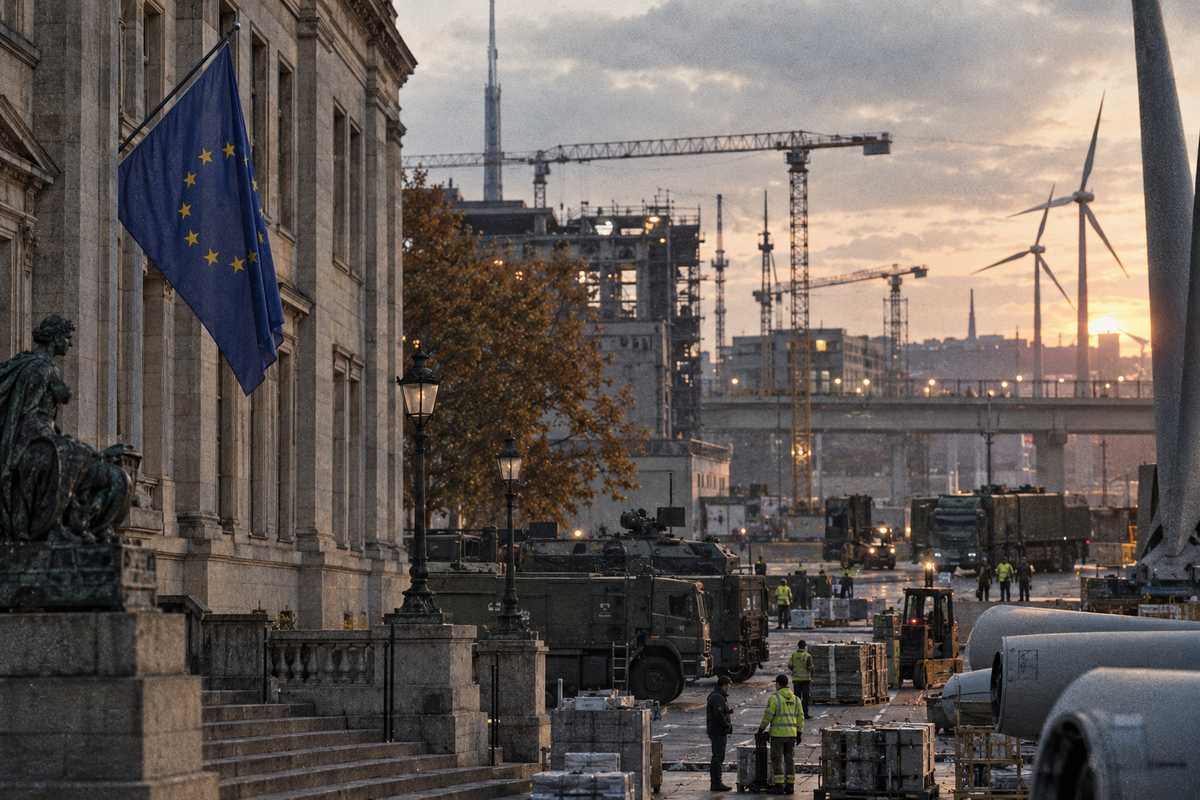
Europe’s New Spending Map
The European Union has approved billions of euros for defence, energy grids and infrastructure. But what does this mean for the management of your wealth, and how should you read these figures? Large budgets and political announcements do not mean that the money has already reached specific companies or investments. In the following article, we look at why it is not enough to manage a portfolio according to headlines about where Europe plans to invest. More important is to understand how far public money has actually travelled, whether into signed orders, company revenues or the assets you own.
Several Steps Separate A Budget From Revenue
When a government or the European Union announces a new €10 billion programme, the headline figure alone does not tell you who will benefit from it or when. Several steps stand between a political decision and the revenue of a specific company. Strictly speaking, the money first has to be approved and allocated. Funding for individual programmes follows, along with public procurement, supplier selection, contract signing, production and delivery. Only after this process do public spending commitments begin to turn into orders and revenues for individual companies.
For you as an investor, the size of the announced programme is not the only thing that matters. You should also know where the money currently sits in this process.
A good example is SAFE, the European Union’s new instrument for financing defence investment by member states. The programme is worth €150 billion and provides governments with loans that can be used to finance joint or national purchases of military equipment.
Lithuania, for example, received €956.3 million in its first payment, equal to 15 percent of its total €6.4 billion allocation. The money is already available to the government, but it is not yet revenue for a manufacturer of armoured vehicles, ammunition or air-defence systems. It only becomes so once the state launches procurement, selects a supplier and signs a specific contract.
The European Defence Fund sits at a different stage. It is an EU programme that finances collaborative research and development in defence technologies. In 2026, the European Commission selected 57 projects with total funding of €1.07 billion. Of this, €675 million goes to defence capability-development projects and €332 million to research.
The fund’s money is tied to more specific technologies and projects, but it still does not represent large-scale orders for finished equipment. Funding development may lead to future contracts, but it does not in itself guarantee that governments will later buy the system in large volumes.
An investor’s first question should therefore be: how much of the package announced by the EU has already been funded, ordered and contracted?
Where Spending Is Already Creating Concrete Orders
Once public money moves from a budget into a specific contract, the investor can work with much more precise information. The customer is known, as are the supplier, the approximate value of the order and the delivery schedule.
One example is the German defence group Rheinmetall, one of Europe’s largest manufacturers of military equipment, ammunition and air-defence systems.
An international customer of Rheinmetall ordered a low five-figure quantity of 155mm artillery shells in the third quarter. The contract is worth a low hundreds-of-millions of euros. Production has already started and delivery is scheduled for 2027.
At this point, the story is no longer simply that higher European spending may support the defence industry. Part of that demand has already reached a specific company and entered its production plan.
This is what matters in portfolio management. A defence budget shows how much a government or the EU intends to spend. A signed contract shows which company has already turned part of that spending into actual business.
The Route Is Longer In Energy Grids
Not every sector, however, has such a direct path from public budgets to specific orders. The modernisation of Europe’s electricity grids involves more steps between a public programme and the revenue of a manufacturer.
The European Commission selected 235 cross-border energy projects that may benefit from faster permitting and access to funding under the Connecting Europe Facility. This programme supports infrastructure that links the energy networks of member states.
A €600 million call for studies and construction work has also closed. These figures already show where investment is likely to take place, but they still do not tell us which company will supply the transformers, high-voltage cables, substations or other equipment. Financing, procurement and supplier selection still stand between an approved project and an order for a specific manufacturer. This is where another link in the chain becomes important: financing the manufacturers themselves.
The European Investment Bank, the EU’s financing institution, will provide BNP Paribas with up to €350 million of counter-guarantees for manufacturers of grid equipment. BNP Paribas will match that amount, bringing the total volume of bank guarantees to as much as €700 million. According to the EIB, the mechanism could support up to €2.8 billion of investment in electricity grids.
At first glance, €2.8 billion may look like money that will flow directly to manufacturers. That is not how the mechanism works. Large industrial contracts often require bank guarantees for advance payments or for the proper performance of a contract. If a manufacturer takes on several large orders at once, these guarantees can significantly consume its banking capacity.
The EIB programme therefore does not buy transformers or cables directly. It helps banks provide manufacturers with the guarantees they need to accept and execute further orders. This is an earlier signal than a signed contract. The conditions for higher order volumes are improving, but we still do not know which company will benefit or by how much. And even when we know which sector the money is heading towards, it may still not be obvious which companies will ultimately win the contracts.
Public Spending Does Not Always End Up In The Obvious Sector
Public budgets separate defence, energy, transport and infrastructure. A real-world project, however, may combine all of these areas and create business for companies across several industries at once. A good example is the Lithuanian port of Klaipėda, the country’s largest seaport. The European Investment Bank is providing €100 million for a project with a total value of around €201 million. The investment includes military mobility, shore-side electricity for ships, green hydrogen infrastructure and support for offshore wind. Part of the civilian terminal will also be adapted for NATO vessels.
From the government’s perspective, this is simultaneously a defence, transport and energy project. From an investor’s perspective, the more important question is which companies will win the individual contracts. Part of the money may go to construction companies, manufacturers of electrical equipment, port-equipment suppliers, engineering firms or energy companies. A company therefore does not need to be labelled as a defence business to benefit from higher defence spending. Nor does it need to be a traditional energy company to win a contract linked to the modernisation of electricity infrastructure.
A portfolio’s actual exposure to Europe’s investment cycle may therefore be much broader than the name of a sector or fund suggests. Once we know which company has won the contract, however, another important question remains. How quickly can it turn that order into revenue?
An Order Is Not Yet The Full Revenue
A signed contract moves public money much closer to company results, but it still does not mean that the full value will appear in revenue immediately.
Production and delivery determine the timing. Rheinmetall has been expanding its ammunition-production capacity since 2022 and aims to produce around 1.5 million 155mm shells a year by 2030. Production capacity helps show when those orders can turn into revenue. If a company wins contracts faster than it can expand output, deliveries and revenues may be delayed by several years. The same logic applies to electricity grids. Higher investment volumes do not create new production lines for transformers or high-voltage cables overnight. Available manufacturing capacity, labour shortages, components, permitting and long delivery times can all slow execution. A €10 billion programme therefore does not automatically create €10 billion of revenue in a single year. The money may appear in company results gradually, depending on how quickly manufacturers can fulfil individual orders.
At this point, the type of information an investor should follow also changes. Political announcements become less informative and company results become more important.
What To Look For In Company Results
Once public spending reaches specific companies, the most important source of information is no longer the government budget but the company itself.
New orders show what customers have just committed to buy. The order book shows the value of contracts the company still has to fulfil. Capital expenditure shows how much it is investing to expand production. New factories and production lines indicate how much future capacity it is preparing. Delivery schedules, in turn, help estimate when contracts may turn into revenue.
Rheinmetall shows this in its €63.8 billion backlog at the end of 2025 and continued investment in expanding production capacity during the first half of 2026. The headline figure for European defence budgets tells you the size of the opportunity. Orders, backlog and production investment show how much of that opportunity is already reaching a specific company and how quickly it may be converted into revenue.
For portfolio management, knowing that Europe plans to spend more on defence or infrastructure is only the starting point. What matters is how much of that spending has already reached a specific supplier, how much business the company has secured and when it can deliver.
Look beyond the headline number. Ask how much of the money has already reached the companies, funds and private assets you own. Budgets show intent. Contracts show who has won the business. Orders, production capacity and delivery schedules show when that business can turn into revenue.
How to Read Public Spending Through Your Portfolio
Imagine you own shares in an industrial company that supplies equipment for electricity grids. The EU announces a new €5 billion investment programme, but that headline figure alone does not tell you how much of the money the company might actually capture.
So how should you read it? First, look at whether the projects have already been approved and financed. Then check whether the company is reporting new orders, whether its order book is growing and what delivery schedules it is giving. If it is also investing in new production lines, that may indicate that it expects a higher volume of business. Taken together, these figures show whether a large public programme is beginning to turn into real business for a company you own.
Questions worth asking:
01 How much of the announced programme has already turned into signed contracts?
02 How much of that business could the company realistically capture?
03 Is its order book growing?
04 Does it have enough production capacity?
05 When will deliveries begin, and when could those contracts start appearing in revenue?
Remember that your portfolio does not respond to the size of a political announcement. What matters is how much of that money ultimately reaches the assets you own.
References (APA)
European Commission, Directorate-General for Defence Industry and Space. (2026). SAFE: Security Action for Europe. European Commission.
https://defence-industry-space.ec.europa.eu/eu-defence-industry/safe-security-action-europe_enEuropean Commission, Directorate-General for Defence Industry and Space. (2026, April 15). Commission to invest €1.07 billion in 57 defence projects supporting European Readiness Flagships. European Commission.
https://defence-industry-space.ec.europa.eu/commission-invest-eur107-billion-57-defence-projects-supporting-european-readiness-flagships-2026-04-15_enRheinmetall AG. (2026, September 14). Rheinmetall supplies artillery ammunition to international customer. Rheinmetall.
https://www.rheinmetall.com/en/media/news-watch/news/2026/09/2026-09-14-rheinmetall-supplies-artillery-ammunition-to-international-customerEuropean Commission, Directorate-General for Energy. (2026, April 9). 235 key cross-border energy projects to boost Europe’s interconnectivity. European Commission.
https://energy.ec.europa.eu/news/235-key-cross-border-energy-projects-boost-europes-interconnectivity-2026-04-09_enEuropean Commission, Directorate-General for Energy. (2026, April 30). EU grants worth €600 million available for cross-border energy infrastructure projects. European Commission.
https://energy.ec.europa.eu/news/eu-grants-worth-eu600-million-available-cross-border-energy-infrastructure-projects-2026-04-30_enEuropean Investment Bank. (2026, September 29). EIB and BNP Paribas to mobilise €700 million in guarantees to support European energy grids. European Investment Bank.
https://www.eib.org/en/press/all/2026-322-eib-and-bnp-paribas-to-mobilise-eur700-million-in-guarantees-to-support-european-energy-gridsEuropean Investment Bank. (2026). BNPP Pan-EU Power Grid Package. European Investment Bank.
https://www.eib.org/en/projects/all/20250811European Investment Bank. (2026, September 15). EIB helps transform Lithuania’s port of Klaipėda into defence and clean-energy hub with €100 million in financing. European Investment Bank.
https://www.eib.org/en/press/all/2026-293-eib-helps-transform-lithuania-s-port-of-klaipeda-into-defence-and-clean-energy-hub-with-eur100-million-in-financingRheinmetall AG. (2026, March 11). Rheinmetall presents annual report for 2025. Rheinmetall.
https://www.rheinmetall.com/en/media/news-watch/news/2026/03/2026-03-11-rheinmetall-presents-annual-report-for-2025Rheinmetall AG. (2026, August 6). Rheinmetall’s H1: Strong sales growth and record profitability. Rheinmetall.
https://www.rheinmetall.com/en/media/news-watch/news/2026/08/2026-08-06-rheinmetall-news-half-yearly-financial-report-h1